
Blueprint is cooperative housing development software built for the people who actually do the work: developers, community land trusts, resident groups, and mission-driven sponsors trying to turn a vacant parcel or an at-risk building into permanently affordable, community-owned housing. It pulls the messy, spreadsheet-heavy early stages of a co-op project — feasibility, financing, legal structure, and member intake — into one connected workspace so your team can move from idea to launch without losing months to disconnected tools.
Built By DAO created Blueprint because the hardest part of a housing cooperative is rarely the construction. It's everything that has to line up before a single unit is occupied: proving the numbers work, assembling a viable capital stack, standing up governance that holds, and onboarding members who become owners. Blueprint gives that work a system.
Why cooperative housing development needs better software now
In June 2026, the 21st Century ROAD to Housing Act (H.R.6644) became law — the most significant housing affordability legislation since 1990. Its Velázquez provisions explicitly authorize housing cooperatives within federal housing programs, opening pathways that were previously ambiguous or closed. Co-ops already support roughly 1.5 million families across the country, and the new framework is designed to expand that reach.
For developers and community organizations, that's both an opportunity and a deadline. As funding streams and program eligibility expand, the groups that can model deals quickly, structure them correctly, and demonstrate readiness will be first in line. The ones still wrestling with fragmented spreadsheets and ad hoc legal documents will fall behind.
Blueprint exists to close that gap. It's purpose-built for cooperative ownership models — limited-equity co-ops, market-rate co-ops, and hybrid community ownership structures — rather than retrofitted from conventional rental development tools that assume a single owner and a single exit.
What Blueprint does
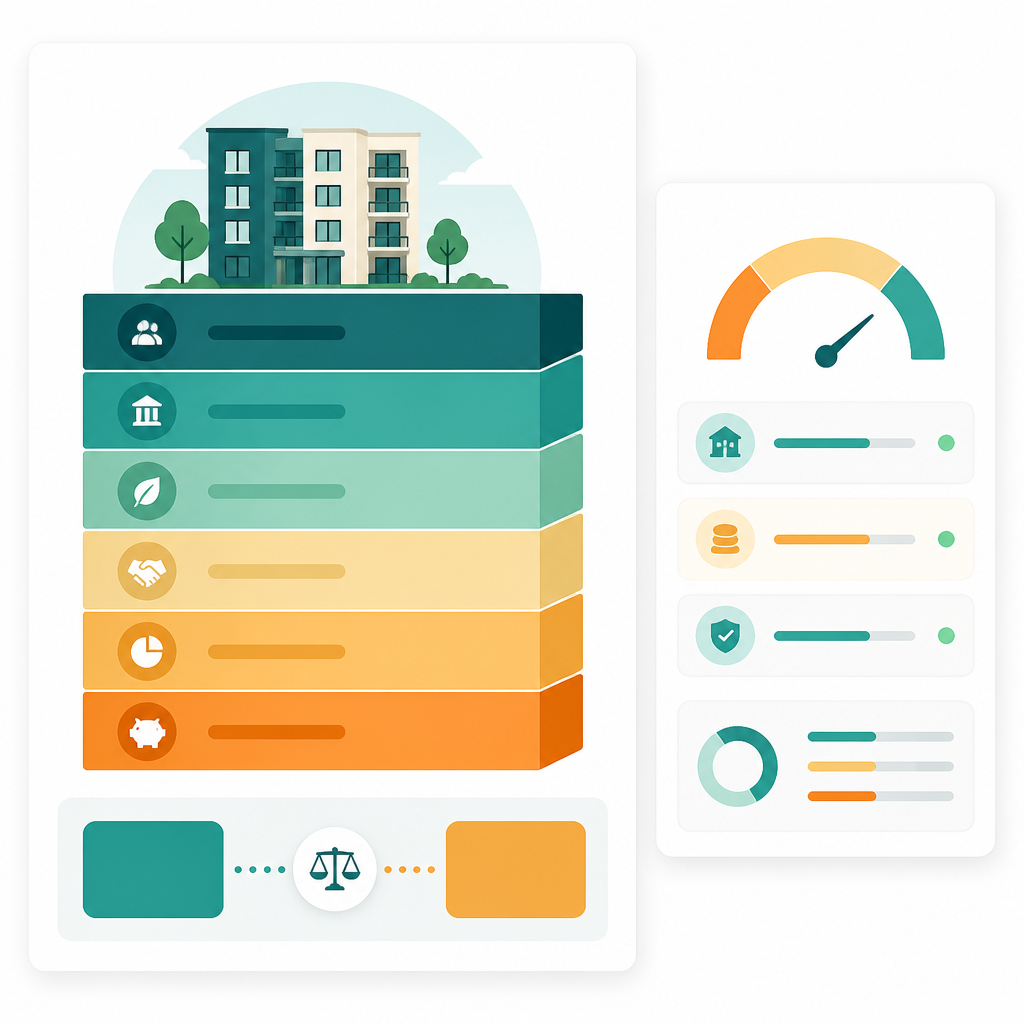
Blueprint organizes a cooperative housing project around five core capabilities. Each works on its own, and together they form a continuous path from first feasibility sketch to an operating, member-owned community.
Feasibility modeling
Before you commit time and capital, Blueprint helps you answer the question that determines everything else: does this deal pencil out as a cooperative?
The feasibility module lets you model acquisition and rehab or new-construction scenarios, project operating costs, and test affordability targets against realistic income bands for your community. You can run side-by-side scenarios — different unit counts, different reserve assumptions, different share prices — and see how each affects monthly carrying costs for members and the long-term health of the cooperative.
Because limited-equity co-ops carry their own math around share appreciation, resale formulas, and reserve requirements, Blueprint's models are structured for cooperative economics specifically, not generic pro formas you have to bend into shape.
Model your first deal in Blueprint →
Capital stack builder
Cooperative deals rarely close on a single source of money. They braid together blanket mortgages, soft second loans, grants, predevelopment funds, sponsor contributions, member share equity, and increasingly, federal program dollars opened up under the ROAD to Housing Act.
Blueprint's capital stack builder lets you assemble these layers visually, track the terms and conditions attached to each source, and see in real time whether your sources cover your uses. As you adjust assumptions in the feasibility model, the stack updates so you're never working from a stale number. When a funder asks how their dollars sit in the structure, you can show them — clearly, in context, with the rest of the stack visible.
The result is fewer surprises at closing and a financing story you can actually walk a lender or a board through.
Governance and bylaws templates
A cooperative is a legal and democratic entity, not just a building. Getting governance right early prevents the disputes and dysfunction that sink co-ops years later.
Blueprint provides structured governance and bylaws templates designed for housing cooperatives — covering membership rights and responsibilities, board structure, voting procedures, share and occupancy agreements, and the policies that govern day-to-day cooperative life. Rather than starting from a blank document or paying to reinvent standard provisions, your team works from a tested framework and adapts it to your jurisdiction and your community's decisions.
These templates are starting points meant to be reviewed with qualified legal counsel for your state and program requirements — Blueprint structures the work, it doesn't replace your attorney. What it does is make sure the foundational documents are coherent, complete, and aligned with the financing and feasibility decisions you've already made.
Member onboarding
Members are what make a cooperative cooperative. Blueprint's member onboarding tools help you move prospective residents through the path from interested applicant to share-holding owner.
You can manage applications, track eligibility and income certification against your affordability targets, collect required documents, and guide members through education and orientation steps. For limited-equity and affordable co-ops where compliance with income limits is non-negotiable, having intake organized in one place — instead of scattered across email and paper — protects both the project and the members.
Onboarding connects back to the feasibility and capital models, so the share structure members are buying into is the same one you financed and modeled. No translation errors between the deal you designed and the deal members actually join.
Compliance tracking
Cooperative housing, especially when it touches public funding, comes with ongoing obligations — income recertifications, reporting requirements, reserve thresholds, affordability covenants, and program-specific rules that now include the new federal cooperative provisions.
Blueprint's compliance tracking gives your team a single view of what's due, what's been satisfied, and what's at risk. Instead of discovering a missed requirement during an audit, you see deadlines and obligations as they approach. For developers managing multiple co-ops, or community groups without a full back office, that visibility is the difference between staying in good standing and scrambling.
See how Blueprint handles compliance →
Who Blueprint is for
Blueprint serves the range of people building community-owned housing:
- Developers expanding into cooperative models who need cooperative-specific tooling rather than retrofitted rental software.
- Community development organizations and CDCs standing up co-ops in the neighborhoods they serve.
- Resident and tenant groups converting their buildings to cooperative ownership and needing structure they can actually use.
- Community land trusts combining CLT land stewardship with cooperative ownership on top.
- Technical assistance providers and consultants supporting multiple co-op projects who need a consistent, repeatable workflow.
It's the same philosophy behind Built By DAO's broader ecosystem — including Urban Array's cooperative housing work in disinvested communities — applied as software anyone can pick up.
How Blueprint fits the Built By DAO ecosystem
Blueprint is the flagship product of Built By DAO, a venture studio focused on community-owned development. The team builds tools and ventures that put ownership in the hands of residents and the communities housing is meant to serve. Urban Array develops cooperative housing in disinvested neighborhoods; Running Start Digital extends the studio's capacity; and Blueprint packages the hard-won knowledge of doing this work into software others can run with.
That lineage matters. Blueprint isn't an outsider's guess at what cooperative developers need. It reflects the actual sequence of decisions — feasibility, financing, governance, membership, compliance — that a real co-op has to navigate, in the order they come up.
From idea to launch, in one workspace
The promise of cooperative housing development software is simple: stop losing your project to the seams between tools. Blueprint keeps your feasibility model, your capital stack, your governing documents, your member pipeline, and your compliance calendar in conversation with one another, so a change in one place flows through the rest.
With the ROAD to Housing Act expanding what's possible for co-ops, the developers and community groups who can act decisively will shape the next wave of affordable, community-owned housing. Blueprint is built to help them act.
Frequently asked questions
What is cooperative housing development software?
Cooperative housing development software is a platform that supports the specific tasks of planning, financing, and launching a housing cooperative — including feasibility analysis built for cooperative economics, capital stack assembly, governance and bylaws creation, member onboarding, and ongoing compliance. Blueprint brings these functions into one connected workspace instead of leaving them scattered across spreadsheets and documents.
How does Blueprint help with the ROAD to Housing Act?
The 21st Century ROAD to Housing Act (H.R.6644), passed in June 2026, includes Velázquez provisions that explicitly authorize housing cooperatives in federal housing programs. Blueprint helps developers and community groups move quickly to take advantage of expanded co-op opportunities by structuring feasibility, financing, and compliance work so projects can be modeled and assembled fast. Blueprint is a tool, not legal or program advice — confirm program eligibility with the relevant agencies and counsel.
Is Blueprint only for experienced developers?
No. Blueprint is designed for a range of users — experienced developers, community development organizations, resident groups converting their buildings, community land trusts, and the consultants who support them. The structured workflow and templates are meant to make cooperative development accessible to teams that don't have a large in-house development staff.
Does Blueprint replace my attorney or accountant?
No. Blueprint's governance templates, financial models, and compliance tools organize and accelerate your work, but they are starting points to be reviewed with qualified legal, financial, and program professionals for your jurisdiction. Blueprint structures the process; your advisors validate the specifics.
What types of cooperatives does Blueprint support?
Blueprint is built for cooperative ownership models including limited-equity cooperatives, market-rate cooperatives, and hybrid community ownership structures such as co-ops layered on community land trust land. Its feasibility and governance tools are designed around cooperative economics rather than conventional single-owner rental assumptions.
How do I get started?
Visit blueprint.builtbydao.com to start your first project. You can begin with a feasibility model and build outward into financing, governance, and member onboarding as your project takes shape.