
Every affordable housing cooperative starts with the same nervous question: Will the numbers actually work? Blueprint is housing cooperative feasibility analysis software built to answer that question with confidence — before you sign a purchase agreement, before you assemble a capital stack, and long before a single resident becomes a member-owner. Built By DAO created Blueprint so that developers, community land trusts, tenant associations, and resident groups can model a deal end to end, stress-test it against reality, and walk into a lender or city meeting with a pro forma that holds up.
Feasibility is where most community-owned housing dies. Not because the vision is wrong, but because the modeling is done in a fragile spreadsheet that one person understands and nobody can verify. Blueprint replaces that fragility with a structured, transparent model your whole team — and your funders — can trust.
Start modeling your co-op in Blueprint →
Why Feasibility Modeling Decides the Deal
A cooperative housing project is a financial machine with a social mission. Acquisition price, renovation scope, debt terms, reserves, and monthly carrying charges all interact. Push acquisition too high and you price out the very families you're trying to serve. Underfund reserves and the co-op limps into its first capital crisis. Overstate income and your debt service coverage collapses the day a unit goes vacant.
Feasibility modeling is how you see those interactions before they become problems. Blueprint treats the feasibility study as the foundation of the entire development — the document that tells you whether to proceed, restructure, or walk away. Get it right and everything downstream (financing, governance, member recruitment) rests on solid ground.
The timing has never mattered more. The 21st Century ROAD to Housing Act (H.R.6644) was passed by Congress in June 2026 (now law as of July 2026), and its Velázquez provisions explicitly authorize cooperatives within federal housing programs — building on the roughly 1.5 million families already living in cooperative housing. That means more capital, more program pathways, and more communities asking the same question Blueprint was built to answer: is this co-op feasible?
Inside Blueprint's Feasibility Engine
Blueprint breaks feasibility into the components that real underwriters and co-op boards actually scrutinize. Each module feeds the next, so a change in one place ripples through the whole model automatically.
Site and Acquisition Analysis
Feasibility begins with the building and the price. Blueprint's acquisition module lets you enter the target property — address, parcel data, lot size, existing units, condition, and zoning context — and model the full cost of getting to closing.
You capture the purchase price alongside the real costs that spreadsheets routinely forget: due diligence, environmental and physical needs assessments, appraisal, title, legal, and transfer costs. Blueprint converts these into per-unit and per-square-foot metrics so you can instantly compare a 12-unit walk-up against a 40-unit mid-rise on equal footing. When acquisition cost per unit drifts above what the rest of the model can support, you see it immediately — not three months and ten meetings later.
Unit Mix and Program Design
The unit mix is where mission meets math. Blueprint lets you define each unit type — studios, one-bedrooms, two-bedrooms, three-bedrooms, accessible units — with counts, square footage, and target affordability levels expressed as a percentage of Area Median Income (AMI).
Because co-ops serve a band of incomes, Blueprint lets you layer affordability tiers across the building: a portion of units at 30% AMI, more at 50% and 60%, perhaps a few at 80% to support cross-subsidy. The model immediately shows how each mix decision changes total carrying-charge revenue and the income profile of your future membership. This is the difference between a co-op that's affordable on a flyer and one that's affordable in a household's actual monthly budget.
Development Budget
Blueprint builds a complete development budget covering acquisition, hard costs, soft costs, financing costs, and reserves. Hard costs include rehabilitation or new construction by line item, contingency, and escalation. Soft costs cover architecture and engineering, permits, legal and organizational expenses (including the real cost of standing up the cooperative entity), and developer fee where applicable.
Critically, Blueprint forces the conversation about reserves up front. Operating reserves, replacement reserves, and a lease-up or transition reserve are modeled as first-class budget lines, not afterthoughts. Underfunded reserves are the single most common reason a young co-op faces an emergency special assessment its members can't afford — so Blueprint makes that line item impossible to ignore.
See how Blueprint structures a full development budget →
Sources and Uses
The sources and uses statement is the heart of every feasibility study, and Blueprint keeps it live and balanced at all times. On the uses side sits your total development cost from the budget. On the sources side, Blueprint assembles the capital stack: permanent debt, soft or subordinate debt, public subsidy, grants, sponsor equity, and member share contributions.
This is where Blueprint's capital stacking shines. You can layer multiple funding sources — federal programs newly accessible under the ROAD to Housing Act, state and local housing trust funds, CDFI loans, philanthropic grants, and limited-equity member buy-ins — and watch the gap close (or stubbornly refuse to). When uses exceed sources, Blueprint shows the financing gap in dollars and as a share of total cost, so you know exactly how much more subsidy, debt capacity, or scope reduction the deal needs to pencil. No more discovering a six-figure gap after you've already promised units to families.
Operating Pro Forma
A co-op doesn't end at closing — it has to operate for decades. Blueprint's operating pro forma projects stabilized annual operations and extends them across a multi-year horizon so you can see the trajectory, not just year one.
Income is driven by carrying charges (the cooperative equivalent of rent) plus any ancillary income such as parking, laundry, or commercial space. Expenses cover the full operating load: property management, maintenance and repairs, utilities, insurance, property taxes (and any applicable abatement or exemption), administrative costs, and annual reserve deposits. Blueprint then calculates net operating income and debt service coverage ratio (DSCR) for every year of the projection.
Because income and expenses grow at different rates, Blueprint lets you set independent escalation assumptions and surfaces the year — if there is one — when expense growth outpaces carrying-charge growth and DSCR drops below your lender's threshold. Seeing that crossover early lets you fix it with structure instead of a crisis.
Carrying-Charge Affordability Testing
This is the test that matters most to the people who will actually live in the building, and it's where Blueprint sets itself apart from generic real estate underwriting tools. A co-op can be feasible for the lender and still be unaffordable for the members. Blueprint closes that gap.
For each unit type and AMI tier, Blueprint takes the required monthly carrying charge — the figure the operating pro forma needs to cover expenses, debt service, and reserves — and tests it against household income at that affordability level. It calculates the housing-cost-to-income ratio for a representative household and flags any unit type where carrying charges would push members past a 30% cost burden.
The result is a feasibility model that's honest in both directions. If the math only works by overcharging your members, Blueprint tells you, and you can respond by adjusting the unit mix, deepening subsidy, restructuring debt, or rescoping the rehab. The goal isn't a pro forma that merely balances — it's one that keeps housing genuinely affordable for the families it's meant to serve.
Sensitivity Analysis and Scenarios
No assumption survives contact with reality, so Blueprint lets you model multiple scenarios side by side and run sensitivity analysis on the variables that move the deal most: acquisition price, construction cost, interest rate, vacancy, operating expense growth, and subsidy amount.
Want to know what happens if construction comes in 10% over budget, or if the interest rate climbs a point, or if a hoped-for grant doesn't materialize? Build it as a scenario and compare it against your base case across every key metric — financing gap, DSCR, and carrying-charge affordability. This is how you walk into a financing conversation already knowing your downside, and how a co-op board makes a go/no-go decision with eyes open rather than fingers crossed.
Run your first scenario in Blueprint →
From Feasibility to a Funded, Governed Co-op
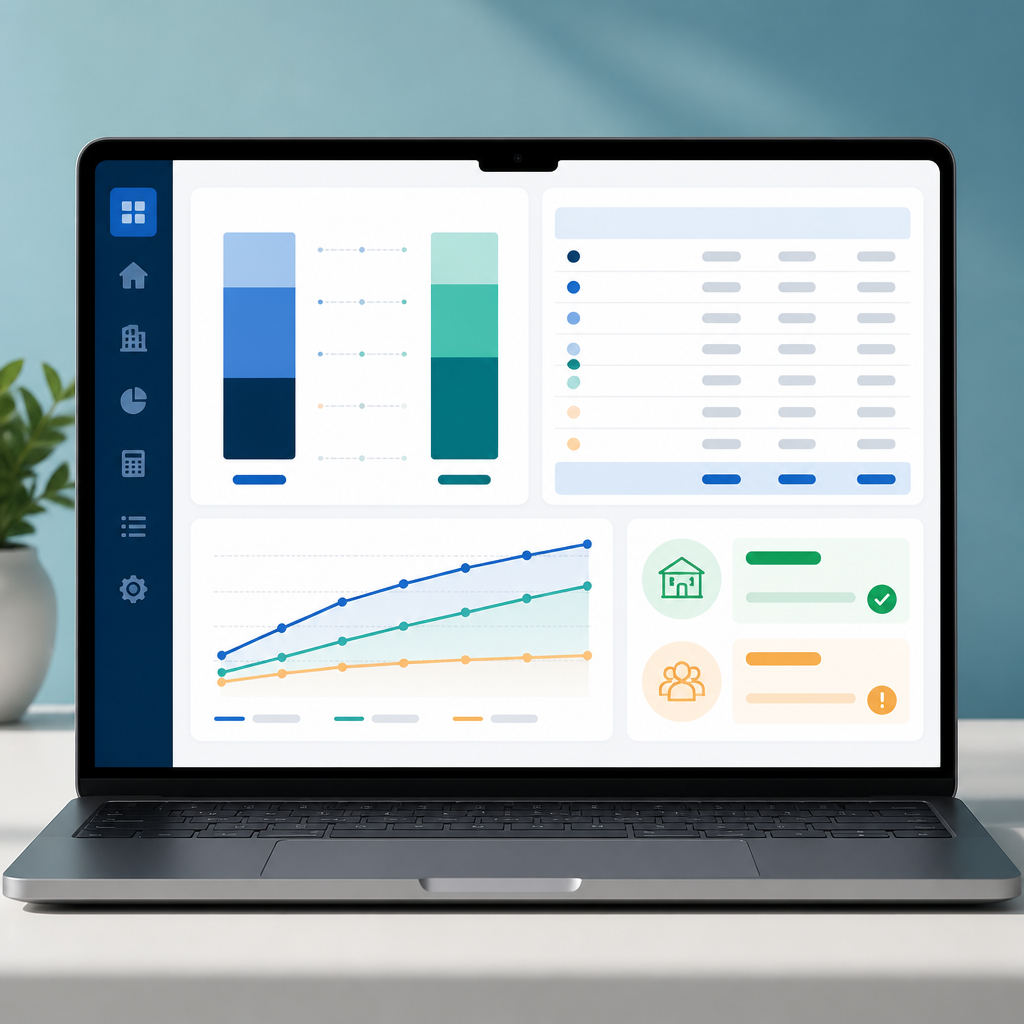
Feasibility is the beginning of the Blueprint story, not the end. Because the feasibility model lives in the same platform as Blueprint's financing, governance, and member management tools, the work you do here flows forward. The capital stack you assembled becomes your financing plan. The unit mix and affordability tiers shape your member recruitment. The carrying charges you tested become the budget your member-owners will govern together.
That continuity is the point of community-owned development. Built By DAO — alongside sister ventures Urban Array and Running Start Digital, under founder Marquis Davis — builds tools for housing that communities own and control. Blueprint exists so that the people closest to a neighborhood can plan, finance, and launch the housing they need, with the same analytical rigor that institutional developers have always had, and a mission those developers rarely share.
With cooperatives now authorized across federal housing programs under the ROAD to Housing Act, the window is open. Blueprint helps you walk through it with a model you can defend.
Build your cooperative housing feasibility model today →
Frequently Asked Questions
What is housing cooperative feasibility analysis software?
It's software that models whether a proposed housing co-op is financially and socially viable — covering acquisition costs, development budget, sources and uses, operating projections, and the affordability of monthly carrying charges for members. Blueprint is purpose-built for cooperative and affordable housing, so it tests not just whether the deal works for lenders but whether it stays affordable for the families who will own and live in it.
Who is Blueprint for?
Blueprint is built for developers, community land trusts, tenant and resident associations, nonprofit housing groups, and community organizers who want to plan, finance, and launch affordable housing cooperatives. You don't need to be a financial analyst — the model structures the work that experienced underwriters do, so first-time co-op developers and seasoned practitioners can both produce a defensible feasibility study.
What is a carrying charge, and why does Blueprint test its affordability?
In a housing cooperative, the carrying charge is the monthly amount each member pays to cover their share of operating expenses, debt service, and reserves — the co-op equivalent of rent. Blueprint tests carrying charges against household income at each affordability tier and flags any unit type where members would face a cost burden above 30%, ensuring the co-op is affordable in practice, not just on paper.
How does Blueprint handle capital stacking and the financing gap?
Blueprint's sources and uses module lets you layer multiple funding sources — permanent and subordinate debt, public subsidy, grants, sponsor equity, and member share contributions — against total development cost. It keeps the statement balanced in real time and shows any financing gap in dollars and as a percentage of cost, so you know exactly how much more capital or scope adjustment the deal needs to pencil.
Does the ROAD to Housing Act affect cooperative housing feasibility?
Yes. The 21st Century ROAD to Housing Act (H.R.6644) was passed by Congress in June 2026, and its Velázquez provisions authorize cooperatives within federal housing programs, building on the roughly 1.5 million families already living in cooperative housing. This expands the funding sources and program pathways available to co-ops — exactly the kind of capital you can model and stack inside Blueprint's sources and uses tool.
Can I run different scenarios to stress-test a deal?
Absolutely. Blueprint lets you build multiple scenarios and run sensitivity analysis on the variables that matter most — acquisition price, construction cost, interest rate, vacancy, expense growth, and subsidy. You can compare a downside case against your base case across financing gap, debt service coverage, and carrying-charge affordability before committing to the deal.