
Choosing between a community land trust vs housing cooperative is one of the most consequential decisions a group of neighbors, organizers, or developers will make when building permanently affordable housing. Both are "shared-equity" models, meaning residents build some wealth while the community keeps homes affordable for the next family. But they solve the affordability problem in structurally different ways, and the right choice depends on your land, your building type, your members, and your financing.
This guide breaks down how each model works, where they overlap, and how hybrid CLT-plus-cooperative structures combine the strengths of both. It is written for community groups deciding which path to take, and it reflects how Built By DAO and our flagship platform Blueprint help cooperatives get planned, financed, and launched.
What Is a Community Land Trust?
A community land trust (CLT) is a nonprofit that acquires and permanently holds land on behalf of a community. The CLT keeps ownership of the land, then leases it to homeowners through a long-term ground lease, typically 99 years and renewable. Residents own the home (or hold a deed) but not the dirt beneath it.
Affordability is preserved through that ground lease and a resale formula. When an owner sells, the formula caps how much the price can rise, balancing two goals: letting the seller walk away with real, earned equity, while keeping the home affordable for the next income-eligible buyer. Resale formulas vary by organization. Common approaches index the resale price to changes in area median income, to a fixed appreciation percentage, or to an "appraisal-based" share of the home's increased value.
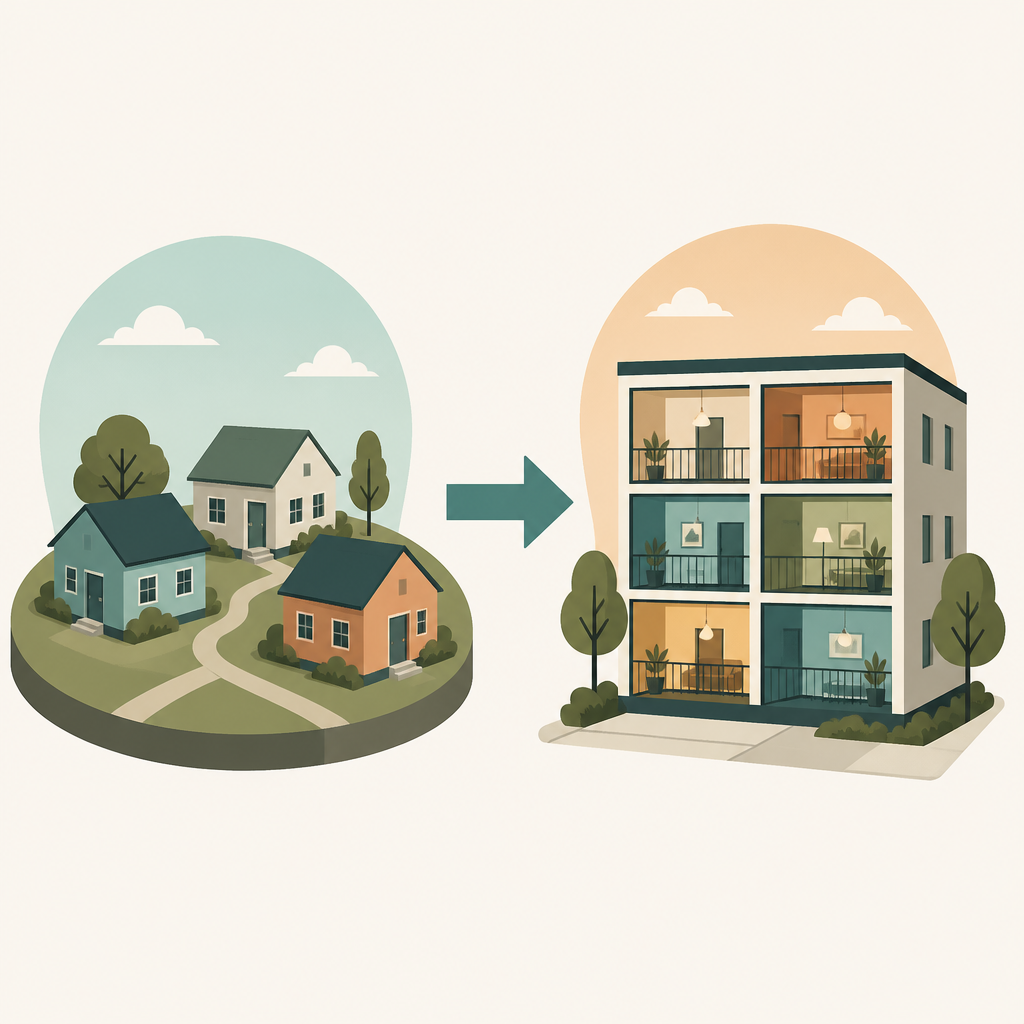
CLTs are most often associated with single-family homes and small ownership units, but the land-trust structure can sit underneath almost any housing type, including the land beneath a cooperative building.
What Is a Housing Cooperative?
A housing cooperative is a corporation that owns one or more residential buildings. Instead of buying a unit outright, you buy a share (sometimes called a membership) in the corporation, and that share gives you the right to occupy a specific unit. You are simultaneously an owner of the whole and a resident of one part.
There are two broad flavors:
- Market-rate co-ops, where shares trade at whatever the market will bear (common in cities like New York).
- Limited-equity housing cooperatives (LEHCs), the affordable variant. Here, the resale price of a share is restricted by the co-op's bylaws, often tied to inflation and frequently capped (by law in some states) at no more than roughly 10% appreciation per year. Because resale gains are limited, the buy-in cost and monthly carrying charges stay well below market, which is what keeps the housing affordable across generations.
Co-ops are inherently collective. Members govern the corporation democratically, usually one-member-one-vote, electing a board and setting the monthly carrying charges that cover the building's blanket mortgage, taxes, maintenance, and reserves.
Community Land Trust vs Housing Cooperative: Side-by-Side Comparison
The clearest way to weigh a community land trust vs housing cooperative is across the five dimensions that actually shape resident experience and project feasibility: ownership, affordability mechanism, governance, resale, and financing.
| Dimension | Community Land Trust (CLT) | Limited-Equity Housing Cooperative (LEHC) |
|---|---|---|
| What you own | The home or improvements; the CLT owns the land under a long-term ground lease (often 99 years). | A share in the corporation that owns the whole building, plus the exclusive right to occupy your unit. |
| Affordability mechanism | Ground lease + resale formula that caps home price appreciation. | Bylaw-restricted share price + limited equity caps on resale, keeping carrying charges low. |
| Governance | CLT board is typically tripartite: leaseholders, community residents, and public/nonprofit representatives. Homeowner controls their own unit. | One-member-one-vote democratic control of the corporation; an elected board runs the building collectively. |
| Resale | Owner sells the home to an income-eligible buyer at the formula price; earns capped appreciation plus paid-down principal. | Member sells the share back to the co-op or to an approved buyer at the restricted price; earns limited, capped appreciation. |
| Financing | Homeowner takes an individual mortgage on the home; ground lease must be lender-approved. CLT may layer subsidy. | Co-op carries a single blanket mortgage on the building; members may take share loans. Carrying charges cover debt service. |
| Typical building type | Scattered single-family homes, townhomes, small condos; can also hold land under multifamily. | Multifamily buildings and townhome clusters under unified ownership. |
| Best for | Preserving affordable homeownership across a neighborhood with mixed building types. | Collective, democratic stewardship of a single multifamily property. |
A few takeaways from the table:
- CLTs separate land from building. That separation is the engine of permanent affordability and works across many housing types.
- Co-ops unify the building under one corporation. That unity is the engine of collective governance and shared maintenance.
- Both cap resale gains. Neither is designed to build market-rate wealth; both are designed to build modest, durable equity while protecting the next family.
The Hybrid: CLT Land Under a Cooperative Building
These models are not rivals. They are frequently described as natural partners, because each fixes a weakness the other has.
In a hybrid CLT + limited-equity co-op, the community land trust owns the land and ground-leases it to a housing cooperative that owns the building. Residents become co-op members with democratic control over their home, while the CLT's ground lease and resale stewardship lock in affordability permanently, even more durably than co-op bylaws alone, which can sometimes be amended or eroded over time.
The hybrid is especially powerful for multifamily affordable housing because it pairs:
- Permanent land stewardship (from the CLT) with
- Collective, democratic resident control (from the co-op), and
- A single blanket mortgage that is simpler to finance than dozens of individual loans.
This is precisely the kind of combined structure that shows up in established affordable-housing portfolios, and it is the model Built By DAO and Blueprint are built to support.
How Built By DAO + Blueprint Fit In
Built By DAO is a venture studio for community-owned development. Through Urban Array, we develop cooperative housing in disinvested communities, and through Blueprint, we provide the software that lets organizers plan, finance, and launch affordable housing cooperatives without needing a developer's rolodex or a lawyer on retainer for every step.
The new 21st Century ROAD to Housing Act (H.R.6644), became law in July 2026 as the largest housing affordability law since 1990, matters here. Its Velázquez provisions explicitly authorize housing cooperatives within federal housing programs, building on the roughly 1.5 million families already living in cooperative housing. For the first time in a generation, co-ops and shared-equity models have clear federal footing, and the groups best positioned to use that footing are the ones who can move from idea to incorporated, financed entity quickly.
That is what Blueprint does. Whether you land on a pure CLT, a limited-equity co-op, or a hybrid that combines both, Blueprint helps you model the resale formula and carrying charges, structure governance, and assemble the financing stack.
Ready to choose and launch your model? Explore Blueprint at blueprint.builtbydao.com to plan, finance, and launch your community's housing cooperative.
How to Decide Which Model Fits
Use these questions as a quick filter:
- What are you building? Scattered single-family homes across a neighborhood lean CLT. A single multifamily building leans co-op. A multifamily building where you want both permanence and democratic control leans hybrid.
- How much do members want to govern collectively? Co-ops require ongoing democratic participation. CLT homeowners govern mostly their own unit.
- How permanent must affordability be? CLT ground leases and stewardship are exceptionally durable. Co-op bylaws are strong but can be amended.
- How will you finance it? One blanket mortgage (co-op) versus many individual mortgages (CLT) changes your lending strategy and underwriting timeline.
- Is there subsidy or land you can secure? A CLT is a natural home for donated or publicly conveyed land. A co-op is a natural home for an existing multifamily building you can convert.
Frequently Asked Questions
Is a community land trust the same as a housing cooperative?
No. A CLT is a nonprofit that owns land and leases it to homeowners with a resale formula; a housing cooperative is a corporation that owns a building, with residents buying shares to occupy units. They use different ownership structures, though they can be combined.
Which builds more wealth, a CLT or a co-op?
Both intentionally cap resale gains, so neither is a wealth-maximizing vehicle. CLT homeowners typically build equity through paid-down mortgage principal plus a capped share of appreciation. Limited-equity co-op members build modest, capped equity on their share. The trade-off in both is durable affordability over maximum upside.
Can you combine a CLT and a housing cooperative?
Yes. In a hybrid model the CLT owns the land and ground-leases it to a cooperative that owns the building. This pairs the CLT's permanent affordability stewardship with the co-op's democratic resident control, and it is a well-recognized structure for multifamily affordable housing.
What is a limited-equity housing cooperative?
A limited-equity housing cooperative (LEHC) is the affordable form of a co-op. Bylaws restrict how much a member's share can appreciate on resale, often tied to inflation and capped, which keeps buy-in costs and monthly carrying charges well below market.
How does the 21st Century ROAD to Housing Act affect co-ops?
The 2026 law's Velázquez provisions explicitly authorize housing cooperatives within federal housing programs, giving co-ops clearer access to federal support and creating new momentum for shared-equity development.
How do I get started with either model?
Define your building type, your members, and your land or financing situation, then model the numbers. Blueprint can help you compare a CLT, a co-op, and a hybrid side by side and move toward an incorporated, financed entity.