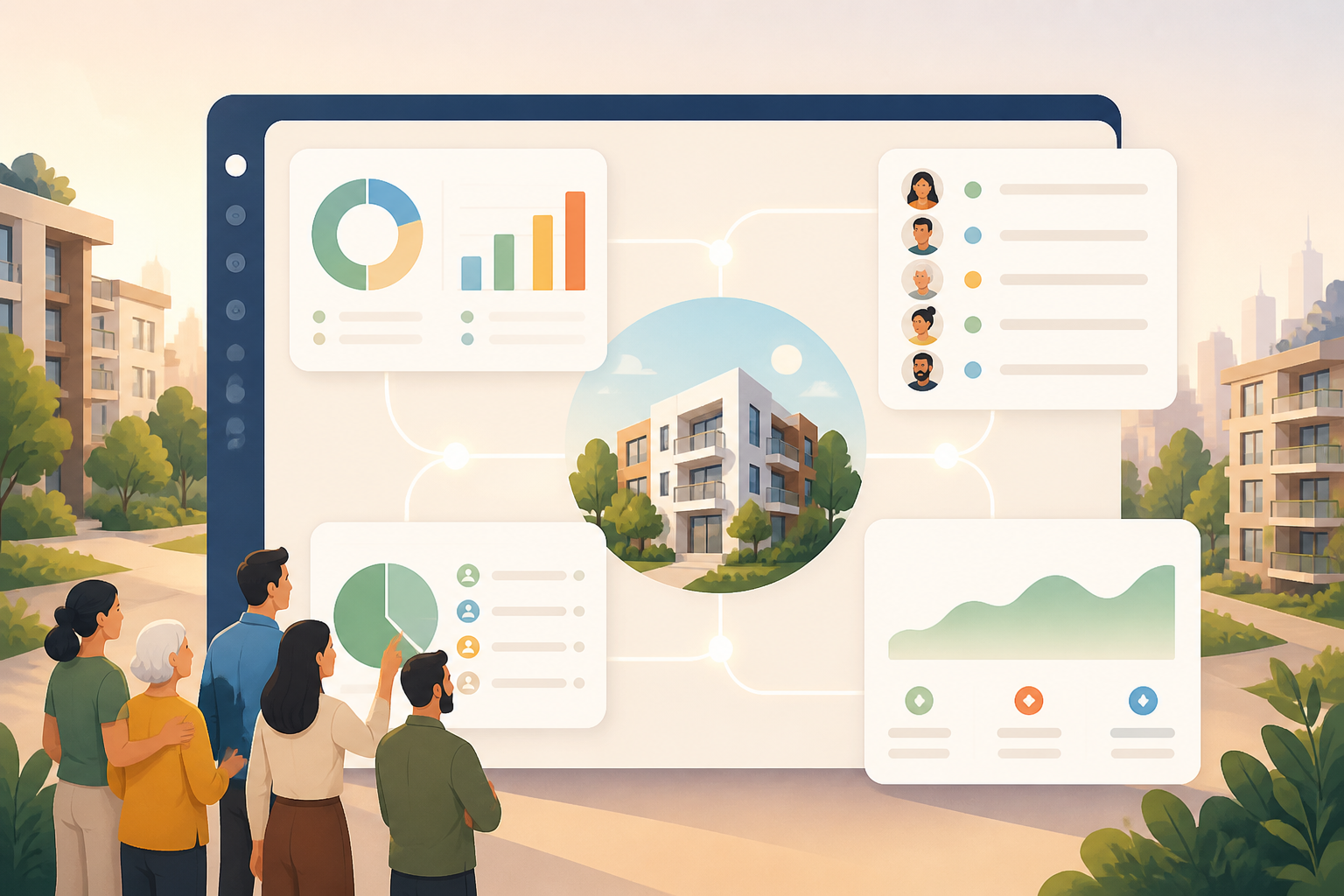
Building a housing cooperative is part real estate development, part democratic organizing, and part long-term property management. Each of those jobs has historically used different software — or no software at all. The result is a fragmented housing cooperative software stack stitched together from spreadsheets, email threads, paper ballots, and disconnected accounting tools. For a small developer or a group of residents trying to convert a building into shared ownership, that fragmentation is one of the quietest reasons co-ops stall before they ever close.
This is a more practical moment than usual to fix that. In June 2026, Congress passed the 21st Century ROAD to Housing Act (H.R.6644) (now law as of July 2026). The Velázquez provisions in that bill authorize cooperatives in federal housing programs and are aimed at a cooperative sector already home to roughly 1.5 million families. When co-ops become eligible for federal programs, the documentation, governance, and underwriting expectations rise with them. The groups that can show clean financials, a defensible capital stack, and a real governance record will be the ones positioned to use those programs. The right technology stack is what produces that record.
This guide walks through each layer of that stack — what it does, why it matters, and where the gaps usually appear — and then explains how an integrated platform like Blueprint connects the layers instead of leaving you to do it by hand.
Why Co-ops Need a Different Stack
A conventional rental developer can often get by with a financial model, a property management tool, and an accountant. A housing cooperative carries extra obligations that ordinary real estate software was never built to handle:
- Shared ownership. Members hold shares or membership interests, not leases alone. Someone has to track those interests, transfers, and the rules around resale.
- Democratic governance. Major decisions go to a vote. Boards are elected. Meetings have quorum requirements and records that may matter legally and for lenders.
- Mission-driven finance. Affordability is usually the point, which means layered, subsidized capital and reserves that have to be protected over decades, not flipped in five years.
- Long horizons. A co-op is meant to last. The tools chosen at formation are often still in use a generation later.
A stack assembled for a typical flip optimizes for none of these. That mismatch is why so many cooperatives end up with software that fights their structure rather than supporting it.
Layer 1: Feasibility and Underwriting
Every cooperative begins with a question: does this actually pencil out? Feasibility and underwriting tools answer it before anyone signs a purchase agreement.
At minimum this layer needs to model development cost, operating expenses, debt service, reserve contributions, and the share price or carrying cost members can realistically afford. For affordable projects, it also has to handle the capital stack — the combination of senior debt, soft loans, grants, tax credits, and member equity that makes the numbers work. Layered financing is where most homegrown spreadsheets break down, because each source has its own conditions, timing, and reporting requirements.
Good underwriting tools let you run scenarios: what happens to member cost if construction runs over, if a grant falls through, or if interest rates move. With federal cooperative eligibility expanding under the ROAD to Housing Act, feasibility models that can incorporate program-specific assumptions are increasingly valuable. A model that produces lender- and agency-ready output is worth far more than one that only convinces the people who built it.
Blueprint's feasibility and capital-stacking tools are built specifically for this work, so a group can test whether a co-op is viable before committing months to it. See how Blueprint handles feasibility and capital stacking.
Layer 2: Project and Development Management
Once a project is viable, it has to be built — or acquired and rehabbed — on a schedule, with a budget, and across a long list of contributors: architects, contractors, attorneys, lenders, and the member group itself.
Project management for co-op development is not fundamentally different from any complex real estate project, but it carries an unusual coordination burden because decisions often route back to a member body rather than a single owner. The tooling needs to track tasks, milestones, draws, and approvals, and keep the member group informed without drowning them in detail. Predevelopment in particular — the long, unglamorous stretch of due diligence, financing, and entitlement — is where many co-ops lose momentum. Software that keeps that phase organized and visible is doing real work, even when nothing is being physically built yet.
Layer 3: Member CRM and Voting
This is the layer that most distinguishes a cooperative stack from an ordinary real estate stack, and the one most often improvised with spreadsheets and group chats.
A member CRM tracks who the members are, their share or membership status, contact details, payment standing, and their history with the co-op — from first interest through onboarding and active participation. During formation it doubles as a pipeline for prospective members. Over the life of the co-op it becomes the authoritative record of who belongs and what they hold.
Voting and governance tooling sits right alongside it. Cooperatives make decisions democratically, which means elections, motions, and referenda with verifiable results. Doing this on paper or by email creates real risk: lost ballots, disputed quorum, no audit trail. Digital voting tied to the member roster ensures only eligible members vote, that results are recorded, and that the co-op can prove its governance held up — which matters for internal trust, for lenders, and increasingly for federal program compliance.
Keeping the member record and the voting system in one place removes a whole category of error. When the roster and the ballot share a source of truth, eligibility is automatic rather than a manual reconciliation. Blueprint includes member management and governance tools designed around exactly this relationship.
Layer 4: Accounting and Reserves
A cooperative's finances have to last as long as the building does. That makes accounting and reserve management a long-term discipline rather than a year-end chore.
The accounting layer handles the ordinary work — member payments, operating expenses, payroll if there is staff, and reporting. What makes co-op accounting distinct is reserves. A reserve study projects when major systems (roofs, boilers, elevators) will need replacement and how much to set aside each year so the money is there when they fail. Underfunded reserves are one of the most common ways shared-ownership housing slides into crisis a decade or two after it opens, when deferred maintenance arrives all at once and there is nothing saved for it.
For affordable and subsidized co-ops, accounting also has to satisfy funders and regulators. Federal programs come with reporting obligations, and a co-op that can produce clean, timely financials keeps its options open. Reserve discipline is not bureaucratic caution — it is what keeps a cooperative solvent across decades and keeps housing affordable for the next generation of members rather than just the first.

Layer 5: Maintenance and Work Orders
Day to day, a cooperative still has to be kept up. The maintenance layer turns resident-reported problems into tracked work orders, assigns them, schedules preventive maintenance, and keeps a history of what was done to each unit and system.
Beyond convenience, this layer feeds the financial one. A real maintenance record tells you what is actually wearing out, which sharpens the reserve study and the operating budget. It also matters for accountability: in a co-op, members are owners, and a transparent maintenance log helps the board show that common funds are being spent on real upkeep. The link between a work-order system and reserve planning is one of the clearest arguments for an integrated stack over disconnected point tools.
Layer 6: Document Management
Cooperatives generate and depend on a large body of documents: articles and bylaws, the proprietary lease or occupancy agreement, share certificates, board minutes, financial statements, loan documents, regulatory agreements, and member files. These have to be stored securely, found quickly, and retained for years.
The risk in poor document management is concrete. A lost regulatory agreement, an unfindable set of minutes, or an outdated bylaw version can stall a refinance, complicate a member dispute, or jeopardize program compliance. As federal cooperative eligibility broadens, the volume and importance of these records only grows. A document layer that ties files to the members, votes, and financial events they relate to turns a filing cabinet into something you can actually rely on under pressure.
How Blueprint Ties the Stack Together
You can assemble these six layers from separate products — a modeling spreadsheet, a project tool, a CRM, a voting service, an accounting package, a maintenance app, and a document store. Many co-ops do. The problem is the seams. Data has to be re-entered, kept in sync by hand, and reconciled when systems disagree. For a volunteer board or a lean development team, the integration work itself becomes a second job, and every seam is a place where errors and disputes live.
Blueprint is built to close those seams. It is software from Built By DAO that helps developers, community groups, and residents plan, finance, and launch affordable housing cooperatives across the whole lifecycle: feasibility and capital stacking, governance and member management. The aim is a single source of truth so that a member's status, their votes, their payments, and the documents that govern them all reference the same record. Feasibility assumptions made at the start carry forward into the financial picture that operations actually report against.
That integration is most valuable precisely where co-ops are weakest. Formation groups often have organizing energy but little development experience; an integrated platform supplies the structure they lack. Established co-ops accumulate years of records across systems that no longer talk to each other; a unified stack consolidates them. And with the ROAD to Housing Act passed by Congress and federal programs opening to cooperatives, the ability to produce coherent, defensible records across feasibility, governance, and finance moves from convenience to qualification.
Built By DAO is a venture studio for community-owned development, and Blueprint is its flagship — built on the premise that the tooling for cooperative housing should be as serious as the tooling for conventional development. The goal is not to add software for its own sake, but to remove the operational friction that keeps good co-ops from forming and keeps existing ones from lasting.
Explore Blueprint and see how the full cooperative stack fits together.
Frequently Asked Questions
What is a housing cooperative software stack?
It is the set of tools a co-op uses across its lifecycle: feasibility and underwriting, project management, member CRM and voting, accounting and reserves, maintenance and work orders, and document management. The "stack" framing matters because these functions are interdependent — feasibility assumptions shape budgets, maintenance records inform reserves, and the member roster governs voting eligibility. Treating them as one connected system rather than seven separate tools is what reduces error and effort.
Can a small co-op or formation group use this kind of software?
Yes, and arguably they benefit most. Formation groups and small co-ops are exactly where fragmented tools and manual reconciliation cause the most damage, because there is little staff to absorb the overhead. An integrated platform like Blueprint is designed to give smaller groups the structure and credibility that larger developers build internally, without requiring them to assemble it from scratch.
How does the ROAD to Housing Act affect cooperatives?
The 21st Century ROAD to Housing Act (H.R.6644) was passed by Congress in June 2026. Its Velázquez provisions authorize cooperatives in federal housing programs and are aimed at a cooperative sector already home to roughly 1.5 million families. Practically, broader federal eligibility raises expectations for documentation, governance records, and financial reporting — which is why a coherent technology stack becomes more important as these programs open to co-ops.
Do I need separate tools for member management and voting?
You can use separate tools, but keeping member records and voting in one system removes a common source of error. When the roster and the ballot share a single source of truth, voter eligibility is enforced automatically and results carry a clean audit trail. Blueprint integrates member management and governance for this reason.
Why are reserves treated as part of the technology stack?
Because reserve health is a long-term financial discipline that depends on data from elsewhere in the stack — especially maintenance history and the original feasibility model. Underfunded reserves are a leading cause of trouble in shared-ownership housing years after it opens. Software that connects maintenance records to reserve planning makes those projections more accurate and the co-op more durable.
What does Blueprint actually do?
Blueprint is software from Built By DAO that helps developers, community groups, and residents plan, finance, and launch affordable housing cooperatives. It covers feasibility, capital stacking, governance, and member management in one integrated platform, so the layers of the cooperative stack reference a shared source of truth instead of being maintained separately. You can learn more at blueprint.builtbydao.com.