
The history of housing cooperatives in America is, at its core, a story about ownership without speculation. For roughly a century, working families have organized to own their homes collectively, govern them democratically, and keep them affordable across generations. A housing cooperative is a corporation that owns a residential building or development; instead of holding a deed to an individual unit, each resident owns a share in that corporation and holds a proprietary lease for their home. That single structural difference, repeated across thousands of buildings, has produced one of the most durable forms of affordable housing the country has ever built.
Today, as the cost of housing strains nearly every American city, the cooperative model is drawing fresh attention from organizers, lenders, and lawmakers alike. To understand why it matters now, it helps to trace where it came from.
The Early Experiments: Unions and Immigrant Communities
The modern American housing cooperative was forged in the labor and immigrant movements of the early twentieth century. Garment workers, machinists, and recent arrivals from Europe pooled their savings to build housing they could afford and control, often in explicit opposition to the crowded, exploitative tenements of the era.
The landmark example is the Amalgamated Housing Cooperative in the Bronx, organized by leaders of the Amalgamated Clothing Workers of America. Its first buildings opened in 1927 near Van Cortlandt Park, developed under New York State's Limited Dividend Housing Companies Law of 1926. The Amalgamated is generally recognized as the oldest limited-equity housing cooperative still operating in the United States, and it established a template that organizers would draw on for decades: a labor-backed sponsor, modest entry costs, resident self-governance, and resale rules that kept apartments affordable rather than letting them be flipped for profit.
Nearby, the United Workers' Cooperative Colony, known as the "Coops," housed left-leaning immigrant families in a community organized around shared culture, education, and mutual aid. These early projects were never large in absolute numbers, but they proved a point that would echo through the rest of the century: ordinary wage earners, organized through institutions they already trusted, could finance and run high-quality housing themselves.
The New Deal and the Postwar Build-Out
The Great Depression reshaped the federal government's relationship to housing. The administration of Franklin D. Roosevelt created new lending institutions, insured mortgages, and launched public housing, fundamentally expanding the public role in shelter. Cooperatives were not the centerpiece of New Deal housing policy, which leaned heavily toward single-family homeownership and public rental housing, but the era normalized the idea that government had a legitimate part to play in making housing affordable and that new financing structures could unlock construction at scale.
After World War II, returning veterans and a growing urban workforce created enormous housing demand. Federal mortgage insurance, expanded under the National Housing Act, was eventually extended to cooperative housing corporations, which helped co-ops access the long-term, lower-cost financing that individual borrowers enjoyed. Labor unions and nonprofit sponsors used these tools to build cooperative developments for their members, continuing the tradition the Amalgamated had started a generation earlier and laying the groundwork for the much larger programs to come.
Mitchell-Lama: Cooperatives at Scale
The most ambitious chapter in the history of housing cooperatives came at the state level. In 1955, New York enacted the Limited-Profit Housing Companies Law, universally known as Mitchell-Lama after its legislative sponsors, State Senator MacNeil Mitchell and Assemblyman Alfred Lama. The program offered private and nonprofit developers low-interest mortgages and property tax abatements in exchange for building moderate-income housing with limited returns and income-restricted residents.
Mitchell-Lama financed both rental buildings and cooperatives, and the cooperative side was substantial. Over roughly the next quarter century, the program helped produce well over a hundred thousand units of moderate-income housing across New York, with cooperatives accounting for a very large share. Sprawling developments such as Co-op City in the Bronx, one of the largest cooperative housing complexes in the world, grew directly out of this framework. The program drew its DNA from the 1920s union experiments and, in turn, became a reference point for federal affordable-housing efforts during the Great Society years.
Mitchell-Lama also exposed a tension that still shapes co-op policy today. Many of its buildings included provisions allowing them to "buy out" of the program after a set period and convert to market-rate housing. As land values rose, some developments did exactly that, removing affordable units from the stock the program had created. The lesson organizers took away was clear: affordability has to be engineered to last, not merely granted at the start.
The Limited-Equity Movement of the 1960s and 1970s
That lesson animated the limited-equity cooperative movement that gathered force in the 1960s and 1970s. A limited-equity housing cooperative caps the price at which a member can resell their share, typically allowing only a modest, formula-based increase tied to inflation or improvements. The trade-off is deliberate: members give up the chance to capture large speculative gains in return for a home that stays permanently affordable to the next working family who buys in.
During these decades, federal programs and a growing network of nonprofit technical-assistance providers helped tenants convert aging or distressed buildings into resident-owned cooperatives, particularly in cities where landlords were abandoning properties. Tenant organizing, sweat equity, and government-backed financing combined to turn renters into owner-members. The movement was uneven and often underfunded, and not every conversion succeeded, but it produced a lasting infrastructure of co-op developers, lenders, and community development corporations, and it cemented limited equity as the affordability mechanism most likely to endure.
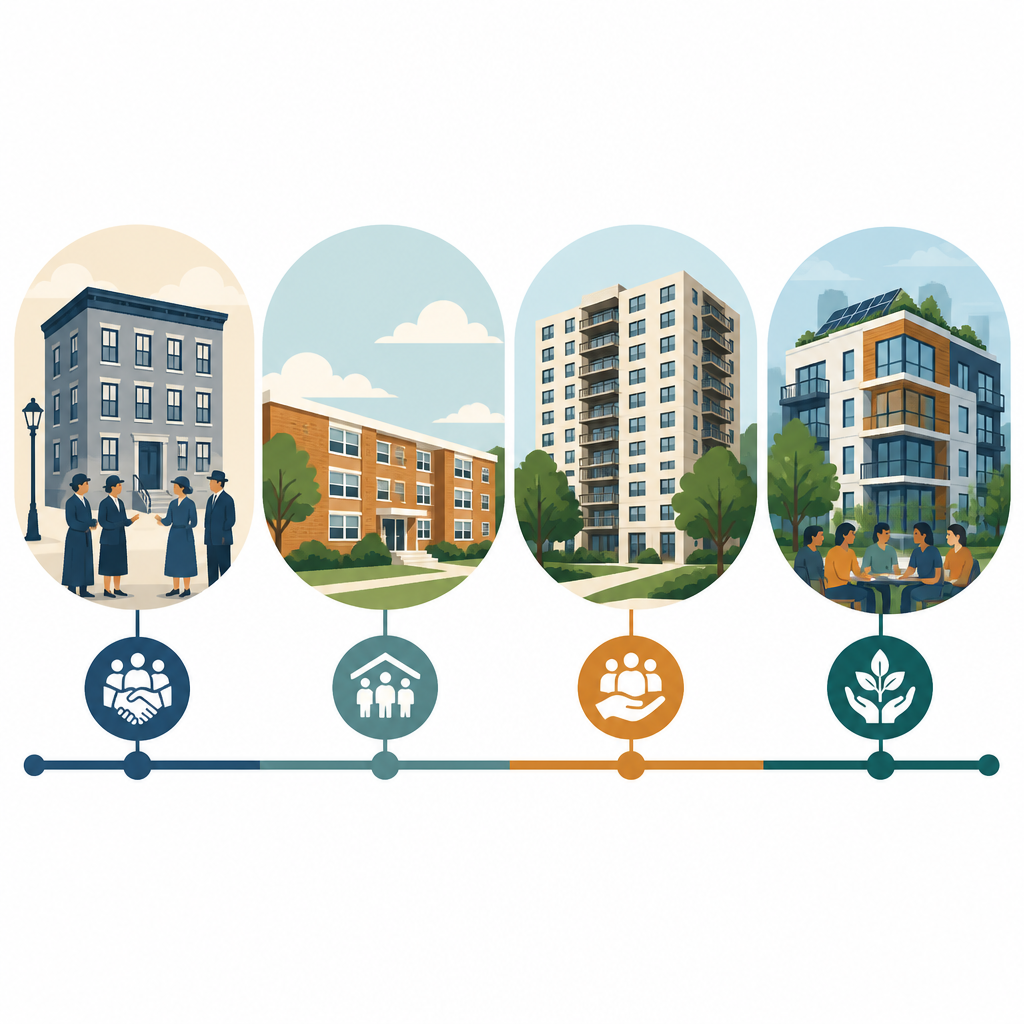
The Modern Revival
For much of the late twentieth century, cooperative housing receded from the national conversation, crowded out by tax-credit rental development and the broader push toward private homeownership. In recent years, it has returned with new energy.
The drivers are familiar to anyone watching housing costs. Decades of underbuilding, rising rents, and stagnant wages have put both renting and traditional homeownership out of reach for millions of households. In that environment, the cooperative's core promise, an ownership stake, democratic control, and durable affordability, looks less like a relic and more like a practical answer. Limited-equity co-ops, community land trusts, and resident-owned communities (including manufactured-home parks purchased by their residents) are all part of a broader movement toward community-owned, permanently affordable housing.
What has historically held the model back is not demand but the difficulty of execution. Forming a cooperative requires legal structuring, financing, governance design, and a long predevelopment process that most community groups are not equipped to navigate. Lowering that barrier is the central challenge of the modern revival, and it is where new policy and new tools are now converging.
The ROAD to Housing Act
That convergence reached a milestone in 2026. The 21st Century ROAD to Housing Act (H.R.6644) was passed by Congress in June 2026 (now law as of July 2026). Among its provisions, language championed by Representative Nydia Velázquez explicitly authorizes housing cooperatives within federal housing programs, clarifying their eligibility and standing in a system that had long been built primarily around individual rental and ownership models.
Establishing cooperatives as a recognized, supported pathway in federal housing programs matters because federal alignment shapes which models lenders, developers, and local agencies are willing to pursue. By naming cooperatives directly, the Velázquez provisions aim to broaden access to financing and program participation for the co-op sector. Estimates associated with the legislation describe its provisions as building on the roughly 1.5 million families already living in cooperative housing, a scale that would mark the most significant federal embrace of the model in generations and a direct descendant of the path that began with a handful of garment workers in the Bronx nearly a century ago.
How Built By DAO + Blueprint fit in
Built By DAO is a venture studio focused on community-owned development. Across its work, including projects under Urban Array and Running Start Digital, and led by founder Marquis Davis, the studio builds tools and ventures that make collective ownership practical rather than aspirational.
Its flagship product, Blueprint, is software designed to help communities plan, finance, and launch affordable housing cooperatives. Blueprint addresses exactly the execution gap that has historically limited the model: it guides a group through structuring the cooperative, modeling its finances, and moving through the steps required to launch. As the ROAD to Housing Act opens federal pathways for co-ops, tools like Blueprint are built to help more communities actually walk through them.
If you are exploring whether a cooperative is the right path for your community, you can learn more and get started at blueprint.builtbydao.com.
Frequently Asked Questions
What is a housing cooperative?
A housing cooperative is a corporation that owns a residential building or development. Residents buy a share in the corporation rather than a deed to a specific unit, and that share comes with a proprietary lease to live in a home and a vote in how the cooperative is governed. Decisions about budgets, maintenance, and policy are made collectively by the member-owners.
What is the difference between a market-rate and a limited-equity co-op?
In a market-rate cooperative, members can resell their shares for whatever the market will bear, so the value rises and falls with local real estate prices. In a limited-equity cooperative, resale prices are capped by a formula, which keeps homes affordable for future members but limits the financial windfall any individual can earn. Limited equity is the mechanism most associated with permanently affordable cooperative housing.
When did housing cooperatives start in the United States?
Organized, large-scale cooperative housing in America dates to the 1920s. The Amalgamated Housing Cooperative in the Bronx, whose first buildings opened in 1927, is widely regarded as the oldest surviving limited-equity housing cooperative in the country and is a touchstone for the movement that followed.
What was the Mitchell-Lama program?
Mitchell-Lama was a New York State program enacted in 1955 that offered developers low-interest financing and tax breaks to build moderate-income housing, including a large number of cooperatives. It produced well over a hundred thousand units across the state and became one of the most significant cooperative housing efforts in American history, though some of its buildings later converted to market rate.
What does the ROAD to Housing Act do for cooperatives?
The 21st Century ROAD to Housing Act (H.R.6644), passed by Congress in June 2026, includes provisions championed by Representative Nydia Velázquez that authorize housing cooperatives within federal housing programs. The provisions are described as building on the roughly 1.5 million families already living in cooperative housing, broadening federal recognition and access for the model.
How can a community start its own housing cooperative?
Starting a cooperative involves legal structuring, financing, governance design, and a predevelopment process. Software like Blueprint from Built By DAO is designed to guide communities through those steps. You can learn more at blueprint.builtbydao.com.