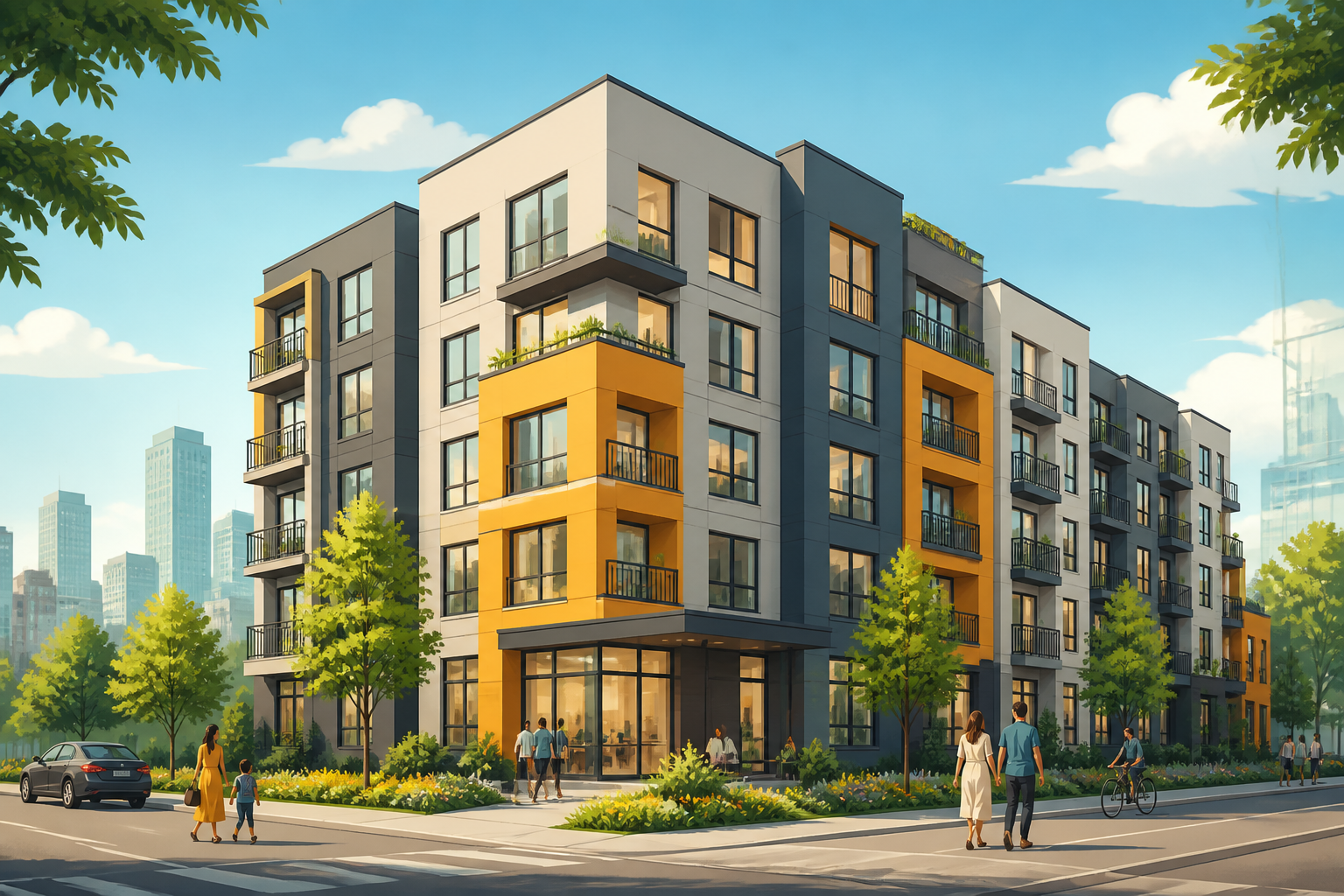
Inclusionary zoning explained simply: it is a land-use policy that ties the creation of affordable homes to the construction of new market-rate housing. When a developer builds a new apartment building or subdivision, an inclusionary zoning (IZ) program asks—or requires—that a share of those homes be set aside at prices working families can actually afford. The idea is to weave affordable units into the same buildings and neighborhoods as market-rate housing, rather than concentrating them in separate, often under-resourced developments.
IZ has become one of the most widely used local affordable-housing tools in the United States. Hundreds of jurisdictions, from large cities like New York and San Francisco to suburban counties and small towns, run some version of an inclusionary program. Yet the details vary enormously, and those details determine whether a program produces meaningful numbers of affordable homes or barely moves the needle. This guide walks through how IZ works, the policy levers cities use, the debates over its effectiveness, and how IZ units can be structured as lasting, community-owned homeownership.
What Inclusionary Zoning Actually Does
At its core, inclusionary zoning leverages private development activity to produce affordable housing without large upfront public subsidy. A city sets a rule: developments above a certain size must include a percentage of income-restricted units. In exchange, the city often grants the developer something valuable in return—extra building height, more units, faster permitting, or fee reductions. The affordable homes are deed-restricted, meaning their price or rent stays capped for a defined period regardless of what the surrounding market does.
The policy emerged in the 1970s, with Montgomery County, Maryland, frequently credited as an early pioneer. Its appeal is intuitive: as a region grows and builds, a slice of that growth is automatically reserved for households who would otherwise be priced out. IZ is fundamentally a tool for economic integration—keeping teachers, nurses, service workers, and seniors living in the communities they serve.
Mandatory vs. Voluntary Inclusionary Zoning
The single most important design choice is whether a program is mandatory or voluntary.
Mandatory Inclusionary Zoning
Under a mandatory program, the affordability requirement is a condition of development. If a project meets the size threshold and falls within the program's geography, the developer must provide the affordable units (or satisfy an approved alternative). Mandatory IZ tends to produce more units because compliance is not optional, and it applies a consistent standard across the market. Critics argue that if the requirements are set too high relative to local economics, mandatory IZ can discourage new construction or push projects to neighboring jurisdictions—though well-calibrated programs paired with offsetting incentives generally avoid that outcome.
Voluntary Inclusionary Zoning
Voluntary (or incentive-based) programs invite developers to include affordable units in exchange for benefits like a density bonus, but do not compel them to. Voluntary IZ is politically easier to adopt and faces fewer legal challenges, but it typically yields fewer affordable homes because developers only participate when the incentive clearly outweighs the cost. Many states and cities run hybrid systems—mandatory in high-demand areas, voluntary or incentive-driven elsewhere.
The Core Policy Levers
Inclusionary zoning is not one rule but a bundle of interlocking design decisions. The following levers shape every program's outcomes.
Set-Aside Percentages
The set-aside is the share of units in a development that must be affordable. Common set-asides range from roughly 10% to 30%, though the right figure depends heavily on local land costs, rents, and the depth of affordability required. A 20% set-aside at 60% of area median income (AMI) is a very different ask than 10% at 80% AMI. Higher set-asides and deeper affordability produce more public benefit per project but also impose more cost, which is why set-asides are usually negotiated alongside incentives.
In-Lieu Fees
Many programs let developers pay an in-lieu fee instead of building the affordable units on site. The city pools these fees and uses them to finance affordable housing elsewhere—often a dedicated, fully affordable project that can serve lower incomes than scattered IZ units typically reach. In-lieu fees add flexibility and can be efficient, but they carry a tradeoff: they undercut the economic-integration goal by allowing affordable homes to be built away from market-rate neighborhoods. The fee must be set carefully. Too low, and developers always pay rather than build, eroding on-site production; too high, and it can stall projects.
Density Bonuses
A density bonus lets a developer build more units (or more square footage) than base zoning would normally allow, in return for including affordable homes. Density bonuses are the workhorse incentive of IZ because additional market-rate units generate the revenue that helps offset the cost of the income-restricted ones. California's statewide Density Bonus Law is among the best-known frameworks, granting escalating bonuses as affordability commitments deepen. Other offsetting incentives include parking reductions, height increases, expedited review, and tax abatements.
Affordability Terms
How long must the units stay affordable, and for whom? Affordability terms specify the income levels served (commonly expressed as a percentage of AMI) and the duration of the restriction. Durations vary widely—some programs lock affordability for 30 years, others for 55 or 99 years, and the strongest aim for permanent affordability. Longer terms protect the public investment and keep homes affordable for successive generations of residents, which is central to building a durable affordable-housing stock rather than one that quietly expires.
The Debate: Does Inclusionary Zoning Work?
Inclusionary zoning is effective and contested in roughly equal measure, and an honest explainer has to present both sides.
The case for IZ. Supporters point out that IZ produces affordable homes in high-opportunity neighborhoods that rarely see subsidized housing, advancing economic and racial integration. It does so largely through private capital, stretching scarce public dollars. And it creates a steady, programmatic pipeline rather than relying on one-off deals. Where programs are well designed and demand is strong, IZ has delivered tens of thousands of units over time.
The case for caution. Skeptics—including some economists—argue that IZ functions as a tax on new housing. If the requirement is not paired with adequate incentives, it can raise the cost of market-rate development, potentially reducing overall supply and nudging prices up for everyone else. Critics also note that production numbers from many programs are modest relative to need, and that in-lieu fees can hollow out on-site delivery. The empirical research is genuinely mixed: outcomes hinge on local market strength and program calibration. A 25% set-aside might work in a booming coastal city and choke off building in a softer market.
The reasonable synthesis is that IZ is a useful tool, not a silver bullet. It works best in strong markets, with set-asides and incentives carefully balanced to local economics, and as one component of a broader strategy that also includes public subsidy, zoning reform that allows more housing overall, and support for nonprofit and community ownership.

Structuring IZ Units as Shared-Equity and Co-op Homeownership
One of the most overlooked questions in inclusionary zoning is what happens to the affordable units over time—especially homeownership units. If an IZ home is sold to a buyer who later resells at full market price, the public benefit vanishes after a single transaction. Shared-equity homeownership solves this.
In a shared-equity model, the buyer purchases the home at an affordable price and builds limited but real equity, while a resale formula keeps the next sale price affordable for the following income-eligible buyer. Common structures include community land trusts (CLTs), deed-restricted resale-restricted homes, and limited-equity housing cooperatives. In a limited-equity co-op, residents collectively own the building through a cooperative corporation and hold shares rather than individual deeds; the share price is capped by formula, locking in affordability while giving members ownership, governance rights, and stability.
Pairing inclusionary zoning with shared-equity and cooperative ownership turns a time-limited affordability restriction into permanently affordable, community-controlled housing. The IZ set-aside seeds the units; the co-op or land-trust structure keeps them affordable in perpetuity. For cities frustrated that hard-won affordable units leak back into the market, this combination is a direct, durable answer.
This approach is gaining ground at the federal level. The 21st Century ROAD to Housing Act (H.R.6644), passed by Congress in June 2026 (now law as of July 2026), includes provisions authored by Representative Nydia Velázquez that authorize housing cooperatives within federal housing programs—provisions aimed at a cooperative sector already home to roughly 1.5 million families. By giving co-ops clearer standing in federal financing and program rules, the law makes it more practical to convert inclusionary and other affordable units into lasting cooperative ownership.
How Built By DAO + Blueprint Fit In
Built By DAO is a venture studio focused on community-owned development—helping neighborhoods, nonprofits, and mission-driven builders create housing that residents actually control. Inclusionary zoning produces units; the harder work is structuring, financing, and governing them so they stay affordable and community-owned for the long term.
That is what Blueprint is built for. Blueprint is our flagship software for planning, financing, and launching affordable housing cooperatives. It helps teams model set-asides and affordability terms, run shared-equity and limited-equity co-op scenarios, assemble financing, and manage the path from concept to a launched, resident-governed cooperative. With cooperatives now explicitly authorized in federal housing programs under the ROAD to Housing Act, the tooling to operationalize co-op ownership matters more than ever.
If your city is creating IZ units—or you want to convert affordable homes into permanently affordable, community-owned cooperatives—Blueprint gives you the planning, financial modeling, and launch tools to do it.
Plan your housing cooperative with Blueprint →
Frequently Asked Questions
What is inclusionary zoning in simple terms?
Inclusionary zoning is a local policy that ties affordable-home creation to new market-rate development. When a developer builds new housing above a certain size, an IZ program requires or encourages that a percentage of the units be set aside at prices affordable to lower- and middle-income households, usually with a deed restriction that keeps them affordable for a set period.
What is the difference between mandatory and voluntary inclusionary zoning?
Mandatory IZ requires developers to include affordable units as a condition of building; it generally produces more units and applies consistently. Voluntary (incentive-based) IZ offers benefits like a density bonus to encourage affordable units but does not compel them; it is easier to adopt but usually delivers fewer homes. Many places use a hybrid of the two.
What are in-lieu fees and density bonuses?
An in-lieu fee lets a developer pay into a city fund instead of building the affordable units on site; the city uses the pooled money to finance affordable housing elsewhere. A density bonus lets a developer build more units or square footage than base zoning allows in exchange for providing affordable homes—the extra market-rate revenue helps offset the cost of the affordable ones.
Does inclusionary zoning actually increase affordable housing?
It can, but results depend on design and local market conditions. Well-calibrated programs in strong markets have produced significant numbers of affordable homes in high-opportunity neighborhoods. Poorly calibrated programs—requirements set too high without offsetting incentives—can discourage construction. The research is mixed, so IZ works best as one part of a broader housing strategy rather than a standalone fix.
How long do inclusionary zoning units stay affordable?
It varies by program. Affordability terms commonly run 30, 55, or 99 years, and some programs aim for permanent affordability. Pairing IZ units with shared-equity structures like community land trusts or limited-equity cooperatives can keep homes affordable indefinitely, well beyond a typical deed restriction.
How can inclusionary zoning units become community-owned cooperatives?
IZ units can be structured as shared-equity homeownership—through community land trusts, resale-restricted homes, or limited-equity housing cooperatives. In a co-op, residents collectively own the building and hold price-capped shares, locking in affordability while granting ownership and governance rights. The 21st Century ROAD to Housing Act, passed by Congress in June 2026, authorizes cooperatives in federal housing programs, making this path more viable. Software like Blueprint helps teams model and launch these cooperatives.