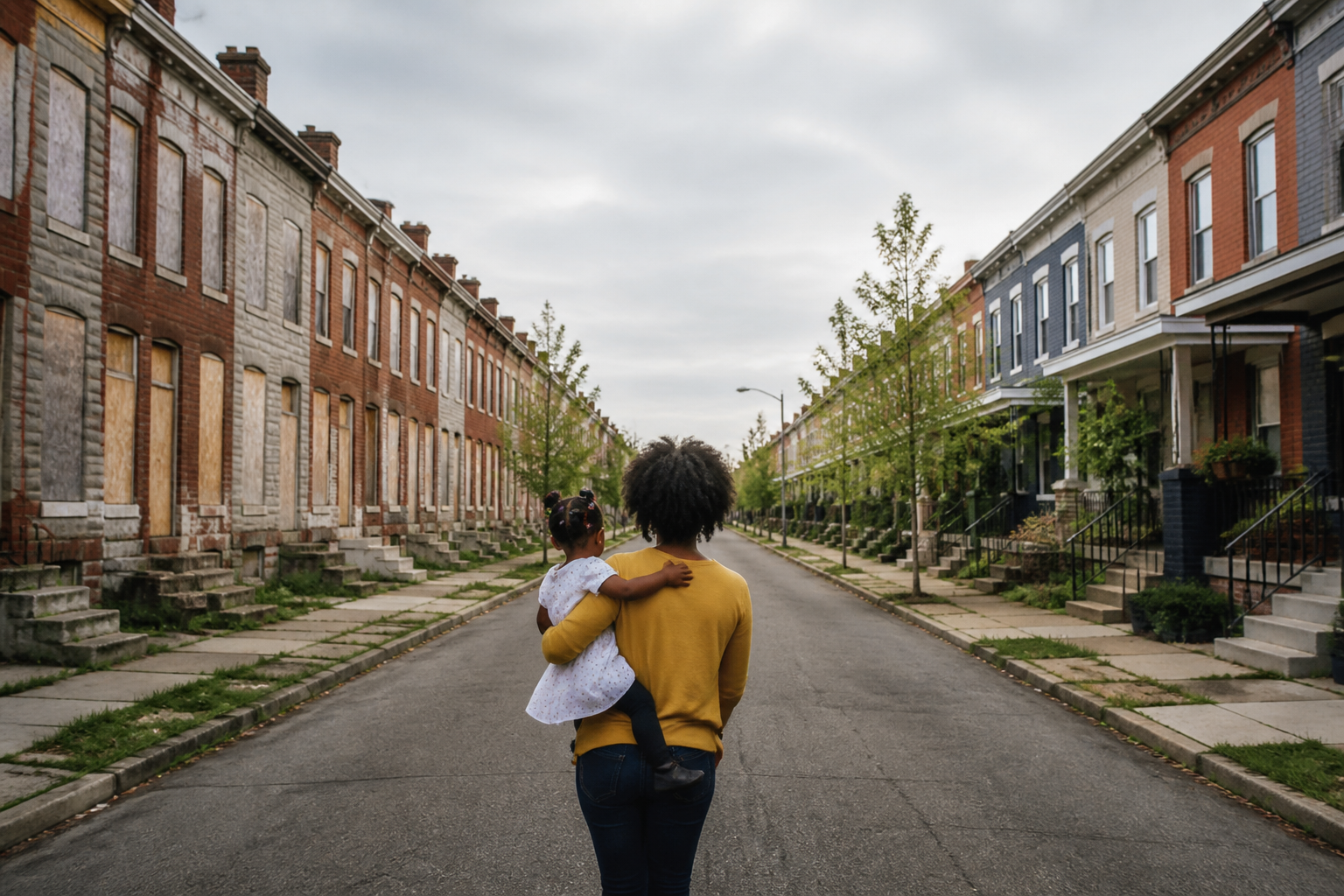
In thousands of American neighborhoods, the cheapest land sits in plain sight: tax-delinquent lots, boarded houses, and abandoned buildings whose owners walked away years ago. Using a land bank vacant property affordable housing strategy, communities can convert that idle inventory into homes residents actually own together. Land banks are public or quasi-public entities built for exactly this job — taking control of distressed parcels, clearing the legal cloud over their titles, and steering them toward developers committed to a public purpose rather than the highest bidder. When the receiving developer is a housing cooperative, the result is durable, community-owned housing instead of another speculative flip.
This page explains how land banks work, why vacant and abandoned property is the raw material for cooperative housing, and how recent federal policy has widened the on-ramp for co-ops. It also covers where Built By DAO and its Blueprint platform fit into the pipeline.
What a Land Bank Actually Does
A land bank is a governmental or nonprofit entity created to acquire, hold, manage, and dispose of vacant, abandoned, and tax-foreclosed property. Most states that authorize land banks give them powers that a typical buyer in the open market does not have. Those powers are what make blighted property usable again.
The core functions tend to fall into four buckets:
Acquisition
Land banks acquire property through several channels. The most common is the tax foreclosure process: when a property owner stops paying property taxes, the locality eventually moves to foreclose. Rather than letting that property go to a speculative bidder at auction — who may sit on it, strip it, or flip it — many states allow the land bank to take title directly, often by absorbing the delinquent tax debt. Land banks also receive donated parcels, purchase property outright, and accept transfers from cities and counties holding inventory they cannot manage.
Clearing and curing title
This is the function that makes land banks indispensable. A vacant property that has cycled through tax delinquency, abandonment, and sometimes informal occupancy frequently carries a "clouded" title — back taxes, old mortgages, mechanic's liens, code-enforcement judgments, and unknown heirs. No responsible developer or lender will touch a parcel they cannot insure. Land banks are typically empowered to extinguish delinquent tax liens and to clear other encumbrances through statutory processes, delivering clean, marketable, insurable title to the next owner. Clearing title is slow, technical legal work, and it is the single biggest reason vacant lots stay vacant for decades. Land banks exist to absorb that work.
Holding and stabilizing
Once a land bank holds a parcel, it can maintain it — mowing lots, securing buildings, demolishing structures that are beyond repair, and keeping the property off the speculative market while a responsible end use is arranged. This holding capacity matters because assembling enough adjacent parcels for a viable housing project takes time.
Disposition to mission-aligned owners
Finally, land banks dispose of property. Unlike a tax auction, which rewards whoever bids most, land banks can prioritize disposition based on the intended use and the credibility of the buyer. Many land banks have explicit authority to transfer property below market value to mission developers — nonprofits, community land trusts, and cooperatives — when the proposed use serves a public purpose such as affordable housing. This discretion is the hinge that lets vacant property become community-owned housing rather than another rental held by an out-of-town LLC.
Why Vacant and Abandoned Property Is the Raw Material for Co-ops
Cooperative housing — where residents collectively own and govern the building or development through a corporation or association — depends on getting the acquisition cost low enough that monthly carrying costs stay genuinely affordable. The math of affordability is brutal when land and buildings trade at market prices. The math improves dramatically when the starting parcel is a tax-foreclosed lot or a vacant structure acquired through a land bank at a fraction of market value.
Vacant and abandoned property is abundant in exactly the disinvested communities where cooperative ownership can do the most good. These are neighborhoods that lost population and capital over decades, where speculation now circles as values tick upward. Converting that vacant inventory into resident-owned co-ops accomplishes three things at once:
- It removes blight. Occupied, maintained homes replace boarded buildings and weed-choked lots that depress surrounding property values and invite crime.
- It builds permanent affordability. A limited-equity cooperative caps resale prices, so the affordability created today is not flipped away tomorrow. The subsidy embedded in a below-market land-bank transfer stays with the community.
- It keeps ownership and wealth local. Residents become owners and decision-makers, not tenants. The appreciation, the equity, and the governance stay in the neighborhood instead of flowing to distant investors.
This is the model Urban Array, a Built By DAO brand, was created to pursue: cooperative housing in disinvested communities, built from the property that the market left behind.
From Vacant Lot to Cooperative: The Pipeline
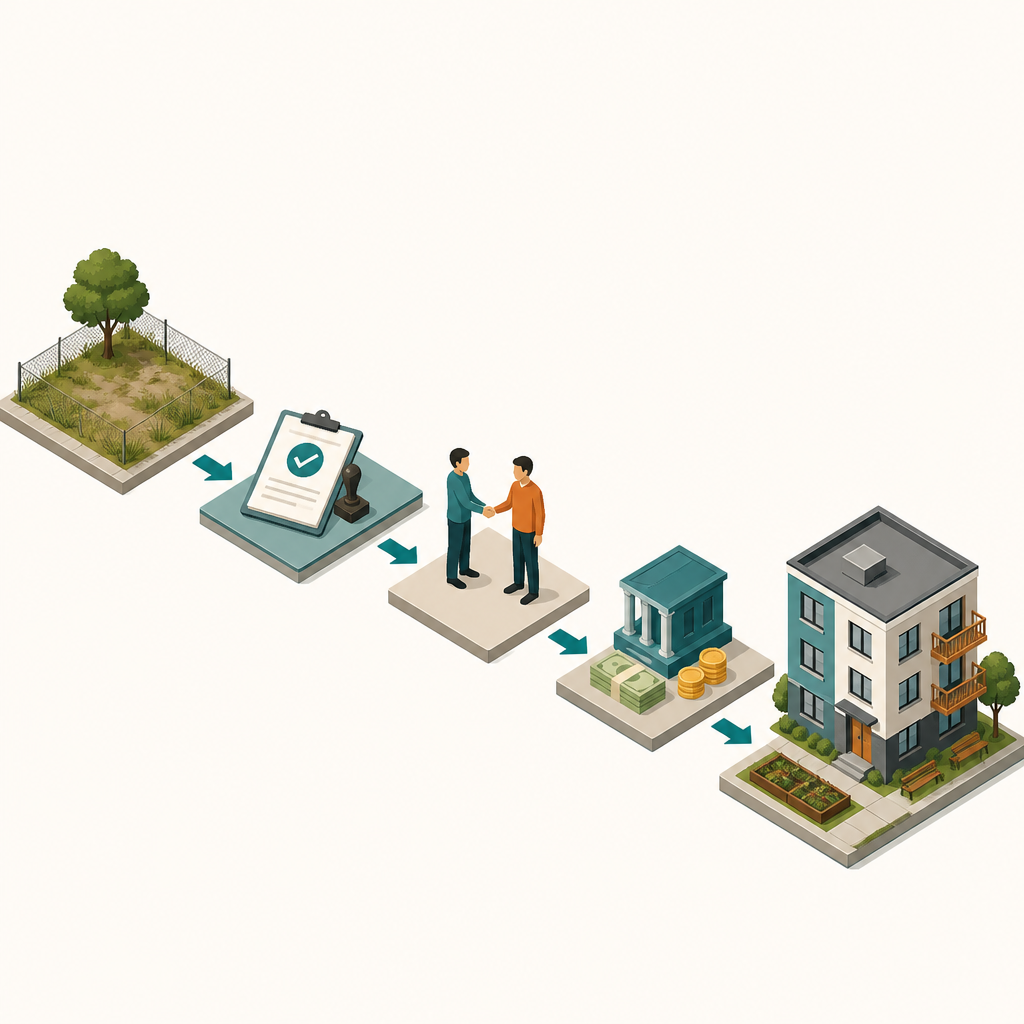
The path from a blighted parcel to a resident-owned co-op runs through a sequence of steps, each of which has historically been a place where good projects die.
- Identify and assemble. Map the vacant, tax-delinquent, and abandoned parcels in a target area. A single lot rarely supports a cooperative; developers usually need to assemble several adjacent parcels into a buildable site.
- Acquire through the land bank. The land bank takes title through tax foreclosure, donation, or purchase, and clears the encumbrances. This is where clouded title gets cured.
- Transfer to a mission developer. The land bank disposes of the cleaned parcels to a cooperative or its sponsoring developer, often below market, with a deed restriction or development agreement tying the land to affordable, community-owned use.
- Finance the project. The developer stacks the capital — federal and state housing subsidies, soft loans, grants, and conventional financing — into a structure that pencils out at affordable rents or carrying costs.
- Develop and incorporate the co-op. Construction or rehabilitation proceeds in parallel with forming the cooperative corporation, drafting governance documents, and recruiting and training resident-owners.
- Launch and govern. Residents move in as members, elect a board, and take over governance and stewardship of the property.
Each step carries legal, financial, and organizational complexity. The two hardest links in the chain are clearing title (the land bank's job) and structuring the finance and the cooperative itself (the developer's job). Get either one wrong and the project stalls.
What Changed in Federal Policy
For years, a structural problem sat underneath all of this: many federal housing programs were written around individual ownership or conventional rental, and cooperatives — especially limited-equity co-ops — did not always fit cleanly into the eligibility rules. A developer could clear title on a vacant building and still struggle to bring federal resources to a cooperative end use.
That gap narrowed in 2026. The 21st Century ROAD to Housing Act (H.R. 6644) was passed by Congress in June 2026 (now law as of July 2026). Among its provisions, language authored by Representative Nydia Velázquez explicitly authorizes housing cooperatives within federal housing programs — clarifying that co-ops are eligible participants rather than an awkward exception. The Velázquez provisions are aimed at a cooperative sector already home to roughly 1.5 million families.
For practitioners turning vacant property into co-ops, this matters in a concrete way. It means the cooperative end use at the bottom of the land-bank pipeline now connects more cleanly to the federal financing tools that make affordability work. The legal clarity reduces the risk that a project clears every other hurdle only to be told its ownership structure does not qualify. Combined with the acquisition advantages land banks already provide, the policy shift strengthens the entire path from blighted parcel to community-owned home.
How Built By DAO + Blueprint Fit In
Built By DAO is a venture studio for community-owned development. Founded by Marquis Davis, it builds the tools, ventures, and capital structures that let communities own what gets built in their neighborhoods. Its brands include Urban Array, which develops cooperative housing in disinvested communities, and Running Start Digital.
The flagship product is Blueprint (blueprint.builtbydao.com) — software to plan, finance, and launch affordable housing cooperatives. Blueprint addresses the second hard link in the pipeline described above: the financial structuring and cooperative formation that follow land acquisition. Where a land bank delivers a clean parcel, Blueprint helps a developer or community group turn that parcel into a financed, governed, resident-owned co-op — modeling the capital stack, organizing the legal and governance work, and managing the launch.
The land-bank pipeline and Blueprint are complementary. Land banks solve acquisition and title; Blueprint solves planning, finance, and launch. Together they shorten the distance from a vacant lot to a home a community owns.
If you are working with a land bank, a city, or a community group on turning vacant property into cooperative housing, explore Blueprint and start planning your project at blueprint.builtbydao.com.
Frequently Asked Questions
How do land banks get vacant property in the first place?
Most land banks acquire property through the tax foreclosure process — when owners stop paying property taxes, the land bank can take title directly, often instead of letting the parcel go to a speculative auction bidder. Land banks also receive donated property, purchase parcels outright, and accept transfers of surplus inventory from cities and counties.
What does "clearing title" mean and why does it matter?
Vacant and abandoned property often carries a clouded title: back taxes, old mortgages, liens, code judgments, and unknown heirs. No lender or responsible developer will invest in a parcel they cannot insure. Land banks are typically empowered to extinguish delinquent tax liens and clear other encumbrances, delivering clean, marketable, insurable title to the next owner. This is the step that has kept countless lots vacant for decades.
Why are cooperatives a good fit for land-bank property?
Cooperative affordability depends on a low acquisition cost. Land banks can transfer tax-foreclosed parcels to mission developers below market value, which lowers the cost basis enough to keep monthly carrying costs affordable. A limited-equity cooperative then locks in that affordability permanently by capping resale prices, so the benefit stays with the community rather than being flipped for profit.
Can land banks really sell property below market value?
Many land banks have explicit statutory authority to dispose of property based on intended use rather than highest price, including transfers below market value to nonprofits, community land trusts, and cooperatives when the use serves a public purpose such as affordable housing. Specific powers vary by state and by the enabling legislation behind each land bank.
How did the 21st Century ROAD to Housing Act change things for co-ops?
The 21st Century ROAD to Housing Act (H.R. 6644) was passed by Congress in June 2026. Provisions authored by Representative Nydia Velázquez explicitly authorize housing cooperatives within federal housing programs, with estimates that they will support roughly 1.5 million families. For developers converting vacant property into co-ops, this connects the cooperative end use more cleanly to federal financing tools.
Where does Blueprint fit in the process?
Land banks handle acquisition and title; Blueprint handles what comes next. Blueprint is software from Built By DAO that helps developers and community groups plan, finance, and launch affordable housing cooperatives — modeling the capital stack, organizing governance and legal formation, and managing the launch of resident-owned co-ops.