Becoming a nonprofit affordable housing developer means building an organization that can plan, finance, build, and steward homes that stay affordable for the long term, not just for a single closing. Unlike a for-profit builder optimizing for the highest return, a nonprofit developer is accountable to a mission and a community. That difference shapes everything: how you incorporate, how you raise money, which programs you qualify for, and who ultimately owns and controls the housing you create.
This guide walks through the real path: forming a mission-driven 501(c)(3), earning Community Housing Development Organization (CHDO) designation, surviving predevelopment, building the partnerships that make deals close, assembling a project pipeline, and growing organizational capacity over time. It also covers a path that has gained new federal footing in 2026: combining nonprofit development with cooperative ownership so residents themselves hold a stake in the homes they live in.
What a Nonprofit Affordable Housing Developer Actually Does
The label "developer" sounds like construction, but development is mostly orchestration. A nonprofit affordable housing developer identifies a need, secures a site, assembles a capital stack from many sources, manages design and construction, and then either operates the property or hands it to a long-term steward. Across that arc, the nonprofit carries financial and legal risk that for-profit partners often will not.
The work falls into a few recurring buckets:
- Site control and acquisition — options, purchase agreements, donations, or land transfers from a city or land bank.
- Financing — layering grants, soft loans, tax credits, and conventional debt into a stack that pencils at affordable rents.
- Design and entitlement — zoning, permitting, community review, and environmental clearance.
- Construction oversight — managing a general contractor against budget and schedule.
- Asset management and stewardship — keeping the property financially healthy and affordable for decades.
Most organizations specialize. Some focus on single-family rehab, others on multifamily new construction, others on preserving existing affordable buildings before they convert to market rate. Choosing a focus early helps you build relevant expertise and a track record that funders trust.
Step 1: Define the Mission and Form a 501(c)(3)
Everything starts with a clear, specific mission. "Build affordable housing" is too broad to guide decisions or convince a funder. A strong mission names a population, a geography, and an approach: for example, preserving naturally occurring affordable rental housing in a specific set of neighborhoods, or developing permanently affordable ownership homes for first-generation buyers.
With a mission defined, the standard legal vehicle is a 501(c)(3) nonprofit corporation. The path runs roughly:
- Incorporate as a nonprofit in your state and adopt bylaws.
- Build a board with the governance, real estate, finance, and community expertise the work demands.
- Apply for federal tax-exempt status with the IRS (Form 1023 or, for smaller startups, the streamlined 1023-EZ).
- Register for state charitable solicitation and any local requirements.
Tax-exempt status matters for more than donations. It unlocks foundation grants, makes you eligible for many government programs, and is a prerequisite for the CHDO designation described below. Many housing nonprofits organize as Community Development Corporations (CDCs) — place-based nonprofits with a broad community-development mandate that frequently includes housing.
Build the board deliberately. Funders and public agencies scrutinize governance, and a board that combines lived community experience with technical real estate and financial knowledge is itself a credibility asset.
Step 2: Earn CHDO Designation
A Community Housing Development Organization (CHDO) is a special designation under the federal HOME Investment Partnerships Program. Participating jurisdictions are required to set aside at least 15 percent of their annual HOME allocation for projects developed, sponsored, or owned by certified CHDOs. Earning the designation effectively reserves a slice of federal funding for organizations like yours.
CHDO requirements are specific and worth reading carefully, because the designation is granted locally by your participating jurisdiction (usually a city or county housing department). In general terms, a CHDO must:
- Be a nonprofit with a tax-exempt ruling and a charitable purpose that includes providing decent affordable housing to low- and moderate-income people.
- Maintain community accountability, typically by reserving at least one-third of board seats for low-income community residents or their elected representatives.
- Demonstrate capacity to carry out HOME-assisted activities, often by showing relevant staff experience or by contracting with experienced consultants during a startup period.
- Have at least one year of serving the community before receiving CHDO set-aside funds.
The requirements are demanding, and that is the point. Designation signals to the jurisdiction that you can be trusted with public dollars. Read your local participating jurisdiction's CHDO certification packet early; the board-composition and capacity rules often shape how you set the organization up in the first place.
Step 3: Survive Predevelopment
Predevelopment is the phase between "we found a site" and "we have a closing." It is where most aspiring developers stall, because it requires spending money before any financing is committed, on work that may reveal the deal cannot proceed.
Typical predevelopment activities include:
- Site analysis and due diligence — title, survey, environmental Phase I (and sometimes Phase II), geotechnical, zoning analysis.
- Preliminary design — enough architecture to estimate costs and test feasibility.
- A development pro forma — modeling sources and uses, operating budgets, and whether the project can carry its debt at affordable rents.
- Community engagement — building support before formal approvals.
- Application preparation — assembling competitive applications for tax credits, HOME, and other funds.
Predevelopment is risky because these costs are sunk if the deal dies. To manage that risk, many nonprofits tap predevelopment loan funds offered by Community Development Financial Institutions (CDFIs), intermediaries, and some public agencies. These provide relatively flexible, sometimes forgivable, capital to cover early costs. Discipline matters here: a clear-eyed pro forma that kills a bad deal early is worth more than optimism that carries a doomed project to a costly dead end.
Step 4: Build the Partnerships That Close Deals
No nonprofit develops alone. The capital stack and the work itself depend on a network of partners, and your job as a developer is to assemble and coordinate them.
Key relationships include:
- Public agencies — city and county housing departments, state housing finance agencies (which allocate Low-Income Housing Tax Credits), and HUD.
- Lenders and CDFIs — for predevelopment, construction, and permanent financing, plus mission-aligned flexible capital.
- Tax-credit investors and syndicators — who provide equity in exchange for LIHTC benefits, often the largest single source in a deal.
- Design and construction teams — architects and general contractors experienced with affordable housing's cost and compliance constraints.
- Experienced co-developers — partnering with a seasoned nonprofit or mission-driven developer on early projects is one of the fastest ways to build a track record while sharing risk.
Treat partnerships as long-term relationships rather than transactions. Funders fund organizations they trust, and trust compounds across projects. A co-development partnership on your first deal can become the reference that wins your second.
Step 5: Build a Project Pipeline
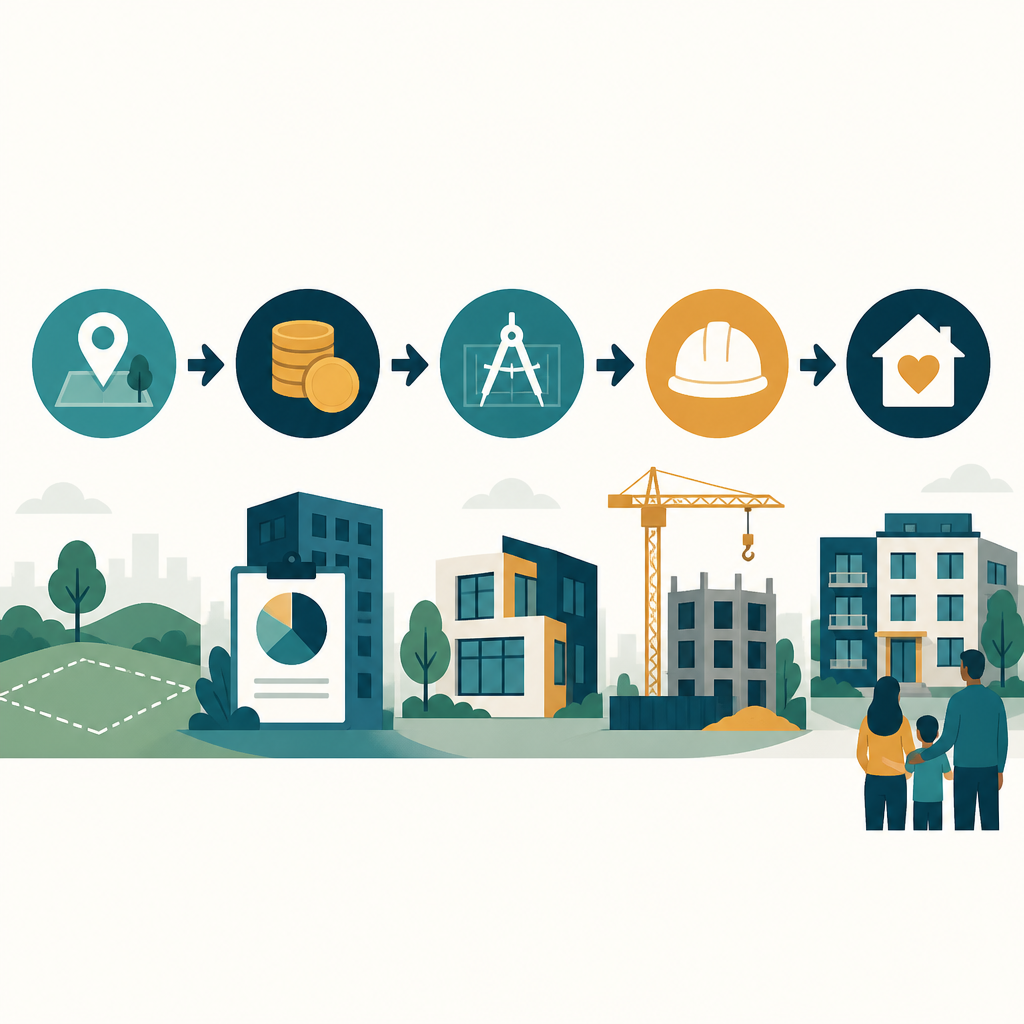
One project does not make a developer; it makes a project. Sustainable nonprofit developers run a pipeline — a sequence of projects at different stages so that as one finishes construction, another is in predevelopment and another is in concept.
A pipeline matters for three reasons. First, it smooths revenue: development fees arrive unevenly, and a pipeline keeps the organization solvent between closings. Second, it builds and retains staff expertise that would otherwise evaporate between one-off projects. Third, it demonstrates to funders and partners that you are a durable institution, not a single-deal entity.
Building a pipeline means continuous site identification, relationship-building with land owners and public agencies that control sites, and the financial discipline to advance only deals that genuinely pencil. It also means saying no — a disciplined pipeline has a graveyard of deals you walked away from for good reasons.
Step 6: Invest in Organizational Capacity
Capacity is the quiet variable that determines whether a nonprofit developer grows or stalls. Capacity includes staff skills, financial systems, asset-management capability, and the cash reserves to weather the gaps between development fees.
Practical capacity-building steps:
- Hire or contract for development expertise — a project manager who has closed deals is worth the cost.
- Build robust financial systems — affordable housing involves complex, multi-source accounting and strict compliance reporting.
- Develop asset-management capability — owning housing means stewarding it for decades; weak asset management can sink an otherwise successful developer.
- Pursue capacity-building grants — many foundations and intermediaries fund organizational development specifically for emerging affordable housing developers.
- Join peer networks — state and national associations of community development organizations offer training, templates, and relationships.
Capacity-building is not a detour from development; it is the foundation that lets you develop more and develop better.
Combining Nonprofit Development with Co-op Ownership
A growing number of nonprofit developers are pairing their work with cooperative ownership, where residents collectively own and democratically govern their housing. In a limited-equity housing cooperative, members buy a share rather than a unit, resale prices are capped to preserve affordability, and the community controls its own building. It is a structure that turns affordability into something residents own rather than something done for them — squarely aligned with a community-development mission.
This approach gained significant new footing in 2026. The 21st Century ROAD to Housing Act (H.R.6644), which was passed by Congress in June 2026 (now law as of July 2026), included provisions championed by Representative Nydia Velázquez that explicitly authorize housing cooperatives within federal housing programs. Those provisions are aimed at a cooperative sector already home to 1.5 million families in cooperative housing — a meaningful expansion of the legal and financial pathways available to nonprofit developers who want to build resident-owned housing rather than conventional rentals.
For a nonprofit developer, co-ops add complexity: member recruitment and education, share financing, cooperative governance, and ongoing member support. But they also deliver something a standard rental cannot — durable, community-controlled affordability and residents with a genuine ownership stake. With federal programs now more explicitly accommodating co-ops, the structure is more practical to finance and replicate than it was even a year ago.
How Built By DAO + Blueprint Fit In
Built By DAO is a venture studio for community-owned development. We exist to make the path described above faster and less intimidating — especially the hardest parts: predevelopment, financing, and standing up a cooperative ownership structure.
Our flagship product, Blueprint, is software that helps mission-driven organizations plan, finance, and launch affordable housing cooperatives. Blueprint guides you through structuring a deal, modeling the financing, and operationalizing co-op ownership — turning the dense, fragmented work of co-op development into a guided process. Alongside Built By DAO, our Urban Array and Running Start Digital efforts support the broader ecosystem of builders, organizers, and community institutions doing this work.
If you are forming a nonprofit developer and want to build resident-owned, permanently affordable housing, Blueprint is built for you.
Explore Blueprint and start planning your housing cooperative →
Frequently Asked Questions
How long does it take to become a nonprofit affordable housing developer?
There is no single timeline, but plan in years, not months. Incorporating and earning 501(c)(3) status can take several months to over a year depending on IRS processing. Building the board, relationships, and capacity to close a first deal — and earning CHDO designation, which typically requires a year of community service first — generally takes one to three years before a first project closes.
Do I need CHDO designation to develop affordable housing?
No. CHDO designation specifically unlocks the HOME program set-aside, but plenty of nonprofit developers operate without it, using other sources such as Low-Income Housing Tax Credits, state and local funds, CDFI financing, and philanthropy. CHDO status is valuable where you want access to HOME set-aside dollars in your jurisdiction.
How do nonprofit developers make money if they're nonprofits?
Nonprofit developers earn development fees — a portion of project costs paid for the work of developing the project — along with asset-management and property-management fees over time. These revenues sustain the organization and fund the mission; they are reinvested rather than distributed to owners, which is the defining feature of a nonprofit.
What is the difference between a CDC and a nonprofit affordable housing developer?
A Community Development Corporation (CDC) is a place-based nonprofit with a broad community-development mandate that often includes housing, jobs, and commercial revitalization. A nonprofit affordable housing developer is defined by its core activity — developing affordable housing. Many CDCs are also affordable housing developers, but a developer can be narrowly focused on housing alone.
How does a housing cooperative differ from regular affordable rental housing?
In a housing cooperative, residents collectively own and govern the housing, buying a share rather than renting a unit. In a limited-equity co-op, resale prices are capped to keep homes affordable for future members. Rental housing is owned by a landlord — even a nonprofit one — while a co-op gives residents ownership, control, and a stake in their community.
Can new federal law really help with cooperative housing?
The 21st Century ROAD to Housing Act (H.R.6644), passed by Congress in June 2026, includes provisions that authorize housing cooperatives within federal housing programs and are aimed at a cooperative sector already home to roughly 1.5 million families. For nonprofit developers, that means clearer legal footing and more program pathways for financing and replicating resident-owned, permanently affordable cooperatives.