
A permanent supportive housing cooperative combines two ideas that are usually kept apart: the deeply supportive, services-rich model that helps people exit homelessness for good, and the community-ownership structure that gives residents a real stake in the place they live. Permanent supportive housing (PSH) pairs long-term, affordable housing with voluntary support services. The cooperative layer adds shared ownership and democratic governance. Put together, they offer a path to stability that treats residents not only as people receiving care, but as members with standing.
This guide explains how the combination works in practice: the Housing First foundation, the wraparound services that make tenancy sustainable, the funding sources that pay for both, and the governance adaptations a co-op needs when many of its members are recovering from homelessness, disability, or chronic illness. It is written for developers, service providers, co-op organizers, and community members who want to understand what is genuinely possible and what it actually takes.
What permanent supportive housing is
Permanent supportive housing is a long-term housing model for people who have experienced chronic homelessness or who face disabling conditions that make stable tenancy difficult without support. "Permanent" means the housing is not time-limited; a resident is not asked to graduate out after a fixed period. "Supportive" means services are available on-site or closely coordinated. The model is widely used for people with serious mental illness, substance use disorders, physical disabilities, HIV/AIDS, and other conditions, and for those whose homelessness has been long or repeated.
PSH is distinct from transitional housing, which is temporary by design, and from emergency shelter, which addresses immediate crisis. The evidence base for PSH is one of the stronger ones in housing policy: it is consistently associated with housing stability and with reduced use of crisis services such as emergency rooms, inpatient psychiatric care, and jails. The reason is intuitive. A stable address makes nearly everything else, treatment, employment, reconnection with family, more achievable.
How a cooperative changes the picture
In a conventional PSH building, residents are tenants. A landlord, often a nonprofit, owns and operates the property. A housing cooperative restructures that relationship. Instead of renting from an owner, members collectively own or control the housing through a cooperative corporation and elect a board from among themselves. In a limited-equity cooperative, resale prices are capped so the homes stay permanently affordable rather than appreciating into the open market.
For formerly homeless and special-needs residents, ownership is not a symbolic gesture. It changes the power dynamic. Members have a vote on house rules, on the operating budget, and on how shared spaces are used. Decisions that would otherwise be made for residents are instead made with them. That shift, from being housed to being a member, can itself be stabilizing. It also builds the kind of mutual accountability and peer support that helps tenancies last.
The Housing First foundation
A credible permanent supportive housing cooperative starts from Housing First. Housing First is the principle that stable housing comes before, not after, a resident addresses other challenges. People are not required to achieve sobriety, demonstrate treatment compliance, or meet other preconditions to obtain or keep their home. Services are offered and strongly encouraged, but participation is voluntary.
This matters in a cooperative because membership and tenancy must not become a new set of hurdles. A co-op committed to Housing First does not condition membership on treatment adherence. It does not evict a member for a relapse alone. House rules focus on the behaviors that protect the safety and rights of the whole community, the same standard any tenancy uses, rather than on policing private struggles. Designed well, the cooperative reinforces Housing First: peers who have walked the same road tend to extend grace and practical help, and a member who has a vote has a reason to stay engaged rather than disappear.
Housing First does not mean services-optional in the sense of services-absent. It means services are available, persistent, and easy to say yes to. The most effective programs combine low-barrier access with assertive, relationship-based outreach, so that the offer of help is always open even when a resident is not ready to take it today.
Wraparound services that make tenancy sustainable
"Wraparound" describes a coordinated set of supports built around each resident's needs rather than a fixed program everyone must fit. In a PSH cooperative, common services include:
- Case management and housing retention support, helping members navigate benefits, appointments, and the ordinary friction of keeping a household running.
- Behavioral health care, including mental health treatment and substance use services, delivered on-site or through close partnerships.
- Primary and preventive health care connections, often the difference between managing a chronic condition and landing in an emergency room.
- Peer support specialists, people with lived experience of homelessness or recovery, who are frequently the most trusted bridge to other services.
- Benefits enrollment and income support, from SSI/SSDI to SNAP to employment services for those who want and are able to work.
- Life-skills and community-building programming that strengthens the social fabric of the building.
The cooperative structure can make wraparound services more durable. Because members govern shared spaces, they can decide to host a clinic day, a peer-support meeting, or a benefits enrollment session in their own community room. Because the board includes residents, service partnerships are shaped by the people who use them. The co-op does not deliver clinical care itself; it partners with qualified providers. But it owns the relationship and the room, which gives services a stable home.
Funding: how the model gets paid for
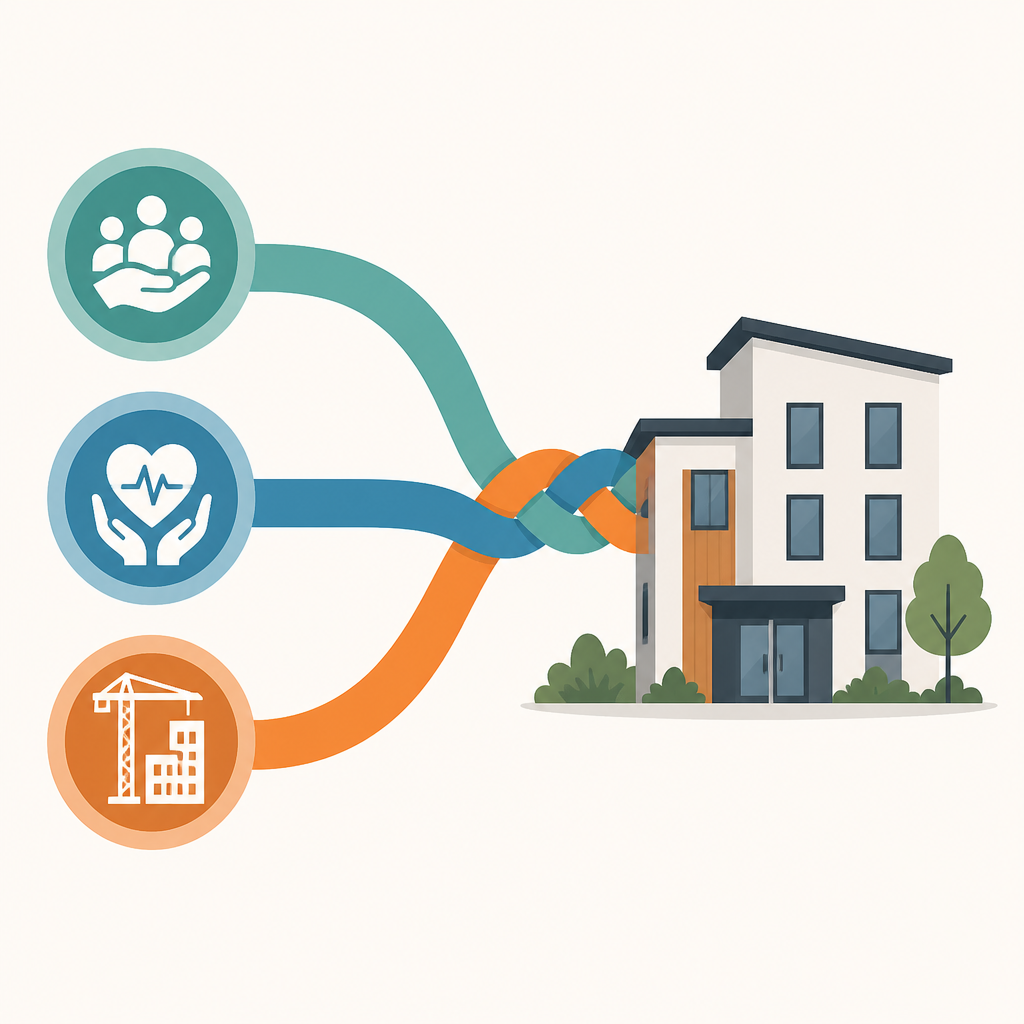
Permanent supportive housing has two cost streams that must be funded separately: the housing (capital to build or acquire, plus ongoing operating and rental subsidy) and the services. A workable PSH cooperative braids several sources.
Continuum of Care
The federal Continuum of Care (CoC) program, administered by HUD, is the backbone of much PSH funding. CoC grants support permanent supportive housing projects, including operating costs, leasing or rental assistance, and supportive services, and they prioritize people experiencing chronic homelessness. CoC funding flows through local CoC bodies that coordinate homelessness response in a given region, so a cooperative pursuing these dollars works within its local CoC's competitive process and its coordinated entry system. CoC is not the only HUD pathway; project-based vouchers and other rental assistance can cover the housing-cost side as well.
Medicaid for services
While HUD generally funds the housing, Medicaid is increasingly the engine for the services side. Medicaid does not pay for rent, but in many states it now covers housing-related supportive services, tenancy-support case management, transition services, and care coordination, particularly for members with disabilities or behavioral health needs. State Medicaid programs structure this differently through waivers, managed care, and other authorities, so the exact menu varies by state. For a PSH cooperative, aligning services with billable Medicaid activities can turn an unstable, grant-dependent service budget into a more sustainable one.
Stacking it together
Most projects combine capital (low-income housing tax credits, state and local housing funds, philanthropic capital), operating subsidy (CoC, vouchers), and services funding (Medicaid, CoC services dollars, state and county behavioral health funds). The braid is intricate, and getting it right is where many good intentions stall. Modeling these layers, who pays for what, when, and for how long, is precisely the kind of planning a cooperative needs to do before it breaks ground.
A changing federal landscape
The funding picture is also shifting at the federal level. The 21st Century ROAD to Housing Act (H.R.6644) was passed by Congress in June 2026 (now law as of July 2026). Its Velázquez provisions explicitly authorize housing cooperatives within federal housing programs, an important recognition that co-ops are a legitimate vehicle for federally supported affordable housing. Supporters have described the cooperative provisions as relevant to roughly 1.5 million families. For organizers building a permanent supportive housing cooperative, clearer federal authorization for co-ops in housing programs reduces a long-standing source of friction: the question of whether the ownership structure even fits the funding.
Governance adaptations for a supportive cooperative
A cooperative assumes members can participate in governance. Many residents of permanent supportive housing can, fully and ably. Others are managing acute conditions, episodic crises, or the lasting effects of trauma and long homelessness. A PSH cooperative has to hold both realities at once: real member power, and real support for exercising it. Several adaptations help.
Tiered or supported membership. Membership rights, the vote, board eligibility, can be designed so participation is genuine but never coercive. A member who is not ready to sit on the board still votes and still belongs. Supported decision-making, where a trusted person helps a member understand and act on choices without taking those choices away, can extend full participation to people who might otherwise be excluded.
A sponsor or steward in the early years. Many PSH cooperatives launch with a nonprofit sponsor that handles compliance, financing, and back-office complexity while resident governance matures. The goal is graduated transfer of control, not permanent paternalism. The structure should name, in writing, how and when authority moves to members.
Separation of services from tenancy decisions. To honor Housing First, the bodies that govern housing should be insulated from the clinical side. A member's standing in the co-op should not hinge on treatment participation, and service providers should not hold eviction power. Keeping these functions distinct protects both the voluntary nature of services and the security of the home.
Conflict resolution built for the population. Trauma-informed mediation, peer-led problem-solving, and clear, fair processes for the rare cases that require them keep small frictions from escalating. The aim is to preserve housing wherever possible, treating termination as a genuine last resort.
Accessible meeting design. Plain-language materials, flexible formats, accommodations for cognitive and psychiatric disabilities, and meeting times that fit members' lives all determine whether governance is real or merely formal.
None of this dilutes the cooperative principle. It operationalizes it for a community whose members deserve both support and a seat at the table.
How Built By DAO + Blueprint fit in
Built By DAO is a venture studio for community-owned development. Through Urban Array, our co-op housing work in disinvested communities, and our broader portfolio, we build the structures that let residents own and govern the places they live. The hardest part of a permanent supportive housing cooperative is rarely the vision; it is the planning, layering CoC and Medicaid and capital sources, modeling operating budgets, and designing governance that is both empowering and sustainable.
That is what Blueprint is for. Blueprint is software to plan, finance, and launch affordable housing cooperatives. It helps organizers model the funding braid, structure limited-equity ownership, and map the governance and service partnerships a supportive co-op needs, before the first dollar is committed. If you are working to bring permanent supportive housing and community ownership together, Blueprint is where you start.
Plan your housing cooperative with Blueprint →
Frequently asked questions
What is a permanent supportive housing cooperative?
It is permanent supportive housing, long-term affordable housing paired with voluntary support services for people exiting homelessness or living with disabilities, structured as a cooperative so residents collectively own or control the property and govern it democratically.
Does cooperative ownership conflict with Housing First?
No. Housing First means housing is not conditioned on treatment or sobriety. A well-designed co-op keeps membership and tenancy separate from service participation, so members are never required to engage in treatment to keep their home. The ownership structure can reinforce Housing First by building peer support and member investment.
Who pays for the services in a PSH cooperative?
Typically a braid of sources. HUD's Continuum of Care program funds housing operations and some services, while Medicaid increasingly covers housing-related supportive services and tenancy-support case management in many states. Medicaid does not pay rent; it funds eligible services.
Can people who are managing serious mental illness or addiction really govern a co-op?
Many can participate fully, and the model is designed to support those who need help doing so, through supported decision-making, tiered membership, peer support, and a nonprofit steward in the early years. Participation is genuine but never coerced.
Does the 21st Century ROAD to Housing Act help?
Yes. H.R.6644, passed by Congress in June 2026, includes Velázquez provisions that authorize housing cooperatives within federal housing programs, building on the roughly 1.5 million families already living in cooperative housing. Clearer federal authorization makes it easier to fit the cooperative ownership structure into federally supported housing.
How is a limited-equity cooperative different from regular homeownership?
In a limited-equity cooperative, members own a share in the cooperative corporation rather than an individual deed, and resale prices are capped. This keeps the homes permanently affordable for the next member rather than allowing them to rise to market rates.