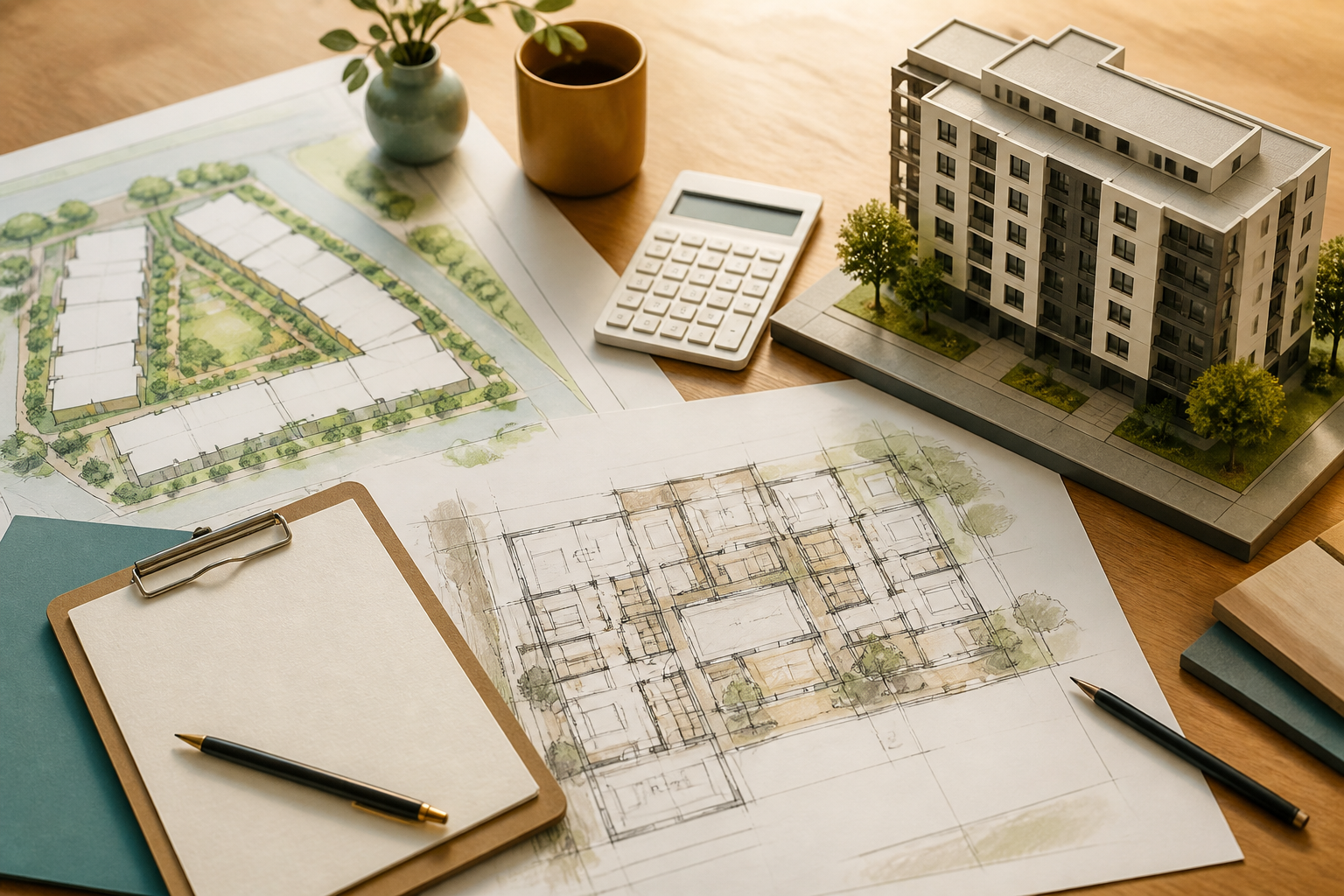
Predevelopment financing for affordable housing is the capital that pays for everything you have to do before a building deal can close. For a housing cooperative, that means the money to study a site, hire architects and lawyers, organize the future member-owners, and assemble the package a construction lender will actually fund. It is the smallest dollar amount in the whole capital stack and, paradoxically, the hardest to raise. This guide explains what predevelopment costs cover, why they carry more risk than any other money in a deal, where co-op sponsors find this capital, and the practical moves that make it easier to secure.
This is an educational overview, not financial, legal, or investment advice. Every project is different, and you should consult qualified counsel, a CPA, and an experienced housing developer before committing money or signing agreements.
What "predevelopment" actually means
A real estate project moves through roughly four stages: predevelopment, acquisition, construction or rehabilitation, and permanent operation. Predevelopment is the front end — the period when a sponsor turns an idea ("we could create a 30-unit limited-equity co-op on this vacant parcel") into a financeable, shovel-ready plan.
Nothing physical happens in predevelopment. No walls go up. Yet this stage decides whether the project is viable at all. By the time predevelopment ends, you should know what the building will cost, who will live there and on what terms, how it will be owned and governed, and whether the numbers close. If they don't, you want to learn that here — when you've spent tens of thousands of dollars — not after you've spent millions.
For cooperatives specifically, predevelopment carries an extra workstream that conventional rental deals don't have: member organizing. A co-op is owned by its residents, so the predevelopment phase includes recruiting prospective members, educating them about cooperative ownership, forming the legal entity, and building the governance structures that will run the building for decades. That organizing work is real, it costs money, and it is essential to the deal.
What predevelopment costs actually pay for
Predevelopment budgets vary widely by project size and complexity, but they consistently fund a similar set of activities:
Site control and options
Before you can study a site seriously, you usually need the legal right to buy it. That often means an option agreement or a purchase contract with an earnest money deposit. Option payments and deposits are predevelopment costs — money at risk before you own anything.
Due diligence
This is the investigative work that confirms whether a deal is real:
- Appraisals and market studies to confirm value and demand
- Environmental assessments (Phase I, and Phase II if needed) to find contamination
- Geotechnical and survey work to understand the land itself
- Property condition assessments on existing buildings being rehabbed
- Title work to confirm clean ownership
Design and engineering
Architects and engineers produce the schematic designs, then progressively detailed drawings, that let you estimate construction costs and apply for permits. Early design fees are predevelopment; you typically can't get an accurate construction loan without them.
Legal and entity formation
Co-ops are legally intensive. Predevelopment legal work includes forming the cooperative corporation, drafting bylaws and occupancy agreements, structuring any limited-equity resale formula, negotiating purchase contracts, and preparing the documents lenders and funders require.
Organizing and consulting
This covers member recruitment and education, community engagement, the housing development consultant who quarterbacks the deal, and the financial modeling that proves the project pencils out.
Application and financing fees
Applying for permanent financing — Low-Income Housing Tax Credits, soft public loans, or the cooperative-eligible federal programs now expanding under recent legislation — carries its own application fees, deposits, and third-party report costs.
A modest co-op might carry a few hundred thousand dollars of predevelopment cost; a larger or more complex project, considerably more. The exact figure matters less than the timing: nearly all of it is spent before there is any committed source to repay it.
Why predevelopment is the riskiest capital in the stack
Lenders and investors talk about predevelopment money as the riskiest dollars in real estate, and the reason is structural, not rhetorical.
It is unsecured by a finished asset. A construction lender holds a mortgage on a building that is being built. A permanent lender holds a mortgage on a building that exists and produces income. Predevelopment capital is spent when there is no building, often no land yet, and no guarantee the project will ever close.
Much of it is non-recoverable if the deal dies. If a Phase II environmental study reveals contamination that kills the project, the money spent on that study — and on the appraisal, the design, the legal work — is gone. There is no collateral to seize and no completed project to refinance. Industry experience is that a meaningful share of predevelopment projects never reach closing.
Repayment depends on a future event that hasn't happened. Predevelopment loans are typically repaid at acquisition or construction closing, out of the larger financing that takes over the deal. If that closing never comes, the loan has no natural repayment source.
Co-ops add complexity. A resident-owned entity is often a newly formed organization with no track record, no balance sheet, and volunteer leadership. Conventional lenders, who underwrite based on sponsor history and net worth, struggle to fit that profile into their boxes.
Because of this risk profile, mainstream banks generally do not make predevelopment loans for affordable co-ops. The capital comes instead from mission-driven sources willing to take losses some of the time in exchange for the social return when projects succeed.

Where predevelopment capital comes from
CDFI predevelopment loans
Community Development Financial Institutions (CDFIs) are the workhorses of predevelopment lending. These mission-driven lenders — loan funds, community development banks, and credit unions — offer predevelopment loans specifically designed for affordable and cooperative housing. Terms are more flexible than bank debt: higher loan-to-cost ratios, tolerance for unconventional sponsors, and underwriting that weighs project viability and mission alongside collateral. Interest rates are usually modest, and many CDFIs pair the loan with technical assistance. National intermediaries such as LISC, Enterprise Community Partners, and the Capital Impact / Momentus Capital family, along with regional CDFIs, are common starting points.
Foundation program-related investments (PRIs)
A program-related investment is a below-market loan or investment made by a private foundation to advance its charitable mission rather than to maximize return. Because PRIs count toward a foundation's required annual distributions, foundations can deploy them at low or zero interest with patient repayment terms. PRIs are well suited to predevelopment because foundations can accept risk and loss that a regulated lender cannot. Many CDFIs are themselves capitalized in part by PRIs, then re-lend that money to projects.
Revolving loan funds
Some cities, states, housing trusts, and cooperative-support organizations operate revolving loan funds dedicated to predevelopment. The structure is simple and durable: a pool of capital lends to projects, gets repaid at closing, and recycles the same dollars into the next project. Cooperative-specific funds — such as those run by national cooperative housing organizations and several state housing finance agencies — exist precisely because conventional capital won't serve this niche.
Grants
Grants are the lowest-risk capital for a sponsor because they don't have to be repaid. Predevelopment grants may come from foundations, municipal or state housing programs, community development block grant (CDBG) funds, faith-based and philanthropic intermediaries, or capacity-building programs aimed at emerging and resident-led developers. Grants are competitive and rarely cover the full predevelopment budget, but even a partial grant reduces the amount of at-risk loan capital a project must carry.
Recoverable grants and sponsor equity
A hybrid worth knowing: the recoverable grant, which functions like a grant unless the project succeeds, at which point it converts to a repayable loan. Sponsors and their partners may also contribute their own equity or deferred fees, signaling commitment to other funders.
How to de-risk predevelopment
You cannot eliminate predevelopment risk, but disciplined sponsors systematically reduce it. The goal is to spend the cheapest, least-committal dollars first and confirm viability before committing larger sums.
Sequence your spending around go/no-go gates. Order the work so the cheapest tests that can kill a deal happen first. A Phase I environmental, a preliminary market read, and a back-of-envelope financial model cost far less than full architectural drawings. Set explicit decision points — if a gate fails, you stop before spending the next, larger tranche.
Secure site control cheaply. A well-structured option gives you time to do due diligence without buying the land outright, capping your exposure to the option price if the deal collapses.
Build a credible capital stack early. Funders want to see that permanent financing is plausible. A realistic sources-and-uses budget, a defensible operating pro forma, and a clear path to construction and permanent debt make predevelopment lenders far more comfortable.
Layer the sources. Combine a grant, a PRI or revolving-fund loan, and modest sponsor equity so no single source bears all the risk — and so a partial loss doesn't sink the sponsor.
Partner with experience. A newly formed co-op paired with a seasoned nonprofit developer or housing development consultant is far more fundable than a first-time entity going it alone. Co-development and technical-assistance relationships transfer track record the project itself lacks.
Engage members and community from the start. For co-ops, demonstrated member demand and organized governance are themselves a form of de-risking — they prove the eventual owners exist and are ready.
A note on policy momentum
Cooperative housing has historically been underserved by federal programs built around rental and individual homeownership. That gap is narrowing. The 21st Century ROAD to Housing Act (H.R. 6644), passed by Congress in June 2026 (now law as of July 2026), includes provisions championed by Representative Nydia Velázquez that expressly authorize cooperatives within federal housing programs — support estimated to reach roughly 1.5 million families. For predevelopment, the significance is that clearer federal eligibility makes the permanent financing at the end of the pipeline more bankable, which in turn makes predevelopment lenders more willing to fund the front end. When the exit is more certain, the riskiest dollars get a little less risky.
How Built By DAO + Blueprint fit in
Built By DAO is a venture studio for community-owned development. Our flagship software, Blueprint, helps sponsors plan, finance, and launch affordable housing cooperatives — including the predevelopment stage this guide describes. Blueprint structures the work into the same go/no-go gates good developers use: it helps you build a sources-and-uses budget, model the pro forma, track due-diligence milestones, and assemble the documentation that CDFIs, PRI funders, and revolving loan funds expect to see. The clearer and more credible your predevelopment package, the easier the capital is to raise.
If you are organizing a co-op and trying to figure out how to fund the work before your first dollar of construction, see how Blueprint can help: blueprint.builtbydao.com.
Frequently asked questions
How much predevelopment financing does a cooperative housing project need?
It depends on the project's size and complexity. Predevelopment is typically the smallest line in the overall budget, but it must cover real costs — options, due diligence, design, legal, and organizing — before any other financing is committed. The practical answer is: enough to reach a financeable, shovel-ready plan, raised from sources that can tolerate the risk of the deal not closing.
Why won't a regular bank fund predevelopment costs?
Predevelopment capital is spent before there is a building — or sometimes land — to secure the loan, and repayment depends on a future closing that may never happen. Conventional banks underwrite against collateral and sponsor track record, which a newly formed co-op usually lacks. That is why CDFIs, foundations, and mission-driven loan funds, which are structured to accept this risk, are the primary sources.
What is a CDFI predevelopment loan?
It is a loan from a Community Development Financial Institution made specifically for the predevelopment phase of an affordable or cooperative project. CDFIs offer flexible underwriting, modest rates, and often technical assistance, and they are usually repaid when the project reaches acquisition or construction closing.
What is a program-related investment (PRI)?
A PRI is a below-market loan or investment a private foundation makes to advance its charitable mission rather than to earn a market return. Because PRIs count toward a foundation's required payout and can absorb risk and loss, they are well suited to funding high-risk predevelopment work directly or by capitalizing CDFIs.
What happens to predevelopment money if the project never closes?
Much of it is non-recoverable. Funds spent on studies, design, and legal work are gone if the deal dies, because there is no completed asset to refinance or collateral to seize. This is exactly why sponsors sequence spending around go/no-go gates and blend grants with patient loans — to cap and share the loss if a project doesn't reach closing.
Does the 21st Century ROAD to Housing Act help with predevelopment financing?
Indirectly but meaningfully. The Act, passed by Congress in June 2026, includes Velázquez provisions that authorize cooperatives within federal housing programs building on the roughly 1.5 million families already living in cooperative housing. By making the permanent financing at the end of the pipeline more accessible to co-ops, it strengthens the projected exit — which makes predevelopment lenders more confident funding the front end.