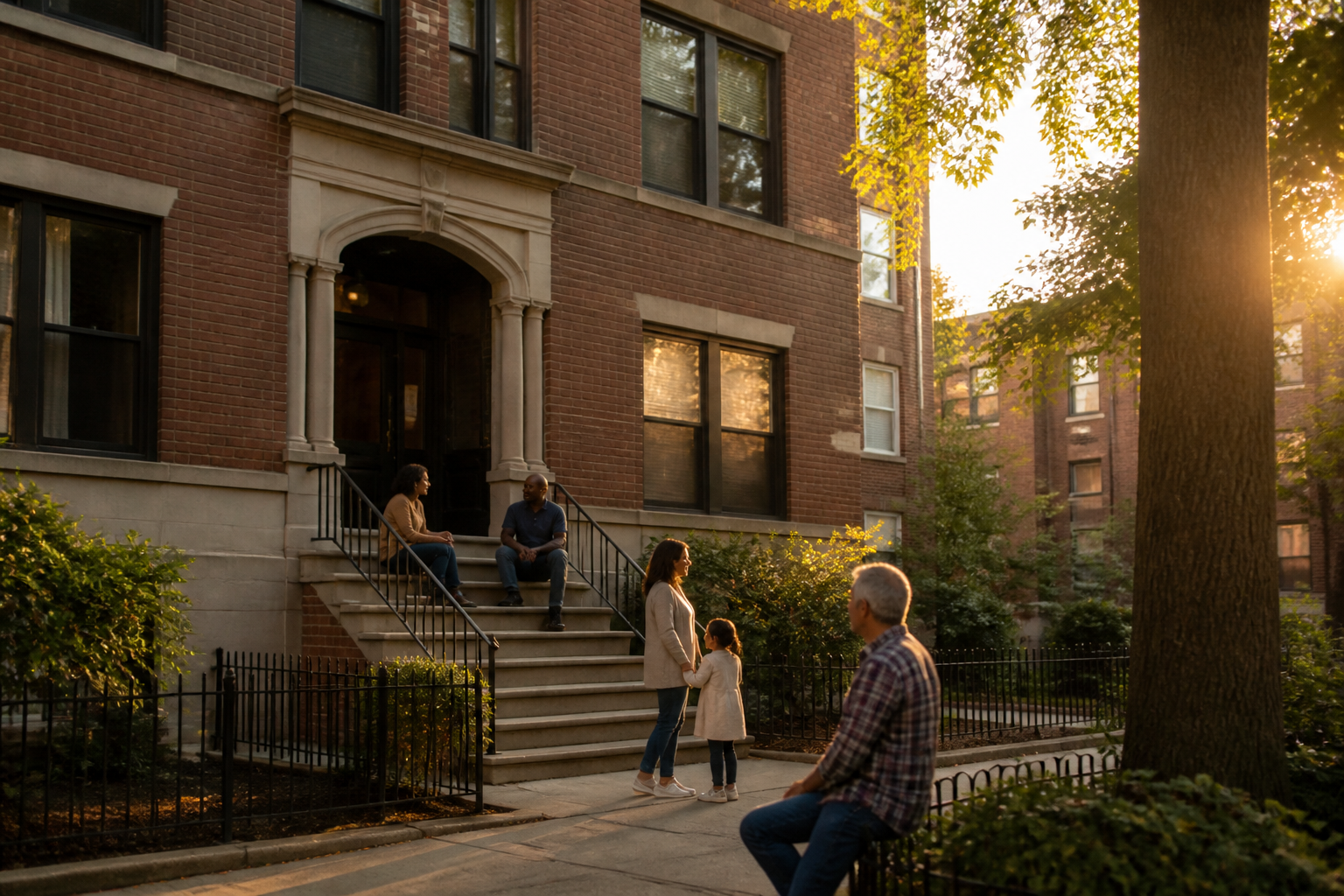
Preserving expiring affordable housing is one of the quietest, highest-stakes problems in American housing policy. Every year, federal affordability restrictions on tens of thousands of apartments reach their end dates. When those restrictions lapse, the homes do not disappear, but the rules that kept them affordable do. Owners gain the legal freedom to raise rents to market rate, opt out of subsidy programs, or sell to buyers with no obligation to keep the units affordable. For the families living in those units, the building looks the same on the outside while the ground shifts underneath them.
This page explains why affordable housing expires, what is at stake when it does, and the concrete strategies that can keep these homes affordable: right of first refusal, recapitalization, transfer to mission-driven owners, and conversion of at-risk properties into resident-owned cooperatives. It also covers how Built By DAO and its Blueprint platform fit into preservation work.
Why Affordable Housing Expires
Most affordable rental housing in the United States is not permanently affordable by design. It is affordable for a defined period, tied to the financing or subsidy that built or rehabilitated it. When the clock runs out, so does the obligation.
Expiring LIHTC restrictions
The Low-Income Housing Tax Credit (LIHTC) is the largest federal program for producing affordable rental housing. In exchange for tax credits, developers agree to keep units affordable to lower-income households for a compliance period, followed by an extended-use period that together typically run 30 years. After year 15, owners can begin a process to exit affordability commitments through what is known as a qualified contract or, eventually, at the end of the extended-use period.
The consequence is a rolling wave of expirations. Properties placed in service in the program's early decades are now reaching the end of their affordability terms, and a steady stream of additional units crosses that threshold each year. Each expiring property is a decision point: re-commit to affordability, or convert to market rate.
Expiring Section 8 and project-based contracts
Project-based rental assistance, commonly associated with Section 8, attaches a subsidy to specific units in a building. These contracts have fixed terms and must be renewed. Owners are generally not required to renew. When a project-based contract expires and the owner opts out, the deep affordability that made those units reachable for very low-income tenants goes away, often abruptly.
Section 8 opt-outs are especially consequential because the affected households tend to be the most rent-burdened. A tenant paying 30 percent of a modest income toward rent under a project-based contract can face a market rent that consumes the majority of that income overnight if the subsidy lapses without a replacement.
Other expiring restrictions
Beyond LIHTC and project-based Section 8, affordability can be tied to older HUD programs, USDA Rural Development financing, tax-exempt bond agreements, and local regulatory agreements. Each has its own timeline and its own exit rules. The common thread is that affordability is a contract with an end date, not a permanent feature of the building.
What Is at Risk When Affordability Ends
Conversion to market rate
The central risk is conversion to market rate. In strong or strengthening rental markets, the gap between the restricted rent and what the unit could command on the open market is large enough that converting is financially attractive to a profit-maximizing owner. The stronger the surrounding market, the greater the pressure to opt out, and the more displacement that follows.
Conversion does not require a developer to do anything dramatic. It often happens through ordinary turnover: as restricted leases end and subsidies lapse, new tenants pay market rent, and the building gradually loses its affordable character without a single press release.
Displacement of existing residents
When rents rise to market, existing residents who cannot absorb the increase move out. Older adults on fixed incomes, families with children, and people with disabilities are frequently among the first affected. Displacement ripples outward, straining nearby housing, schools, and support networks. Replacing a lost affordable unit by building a new one typically costs far more and takes far longer than preserving the unit that already exists.
Loss of irreplaceable housing stock
Preservation advocates often note a hard truth: it is generally cheaper and faster to keep an existing affordable unit affordable than to build a new one. Expiring properties are frequently well located, near transit, jobs, and services, in neighborhoods where new affordable construction is difficult or impossible. Once these units convert, that location advantage is lost to the affordable inventory, often for good.
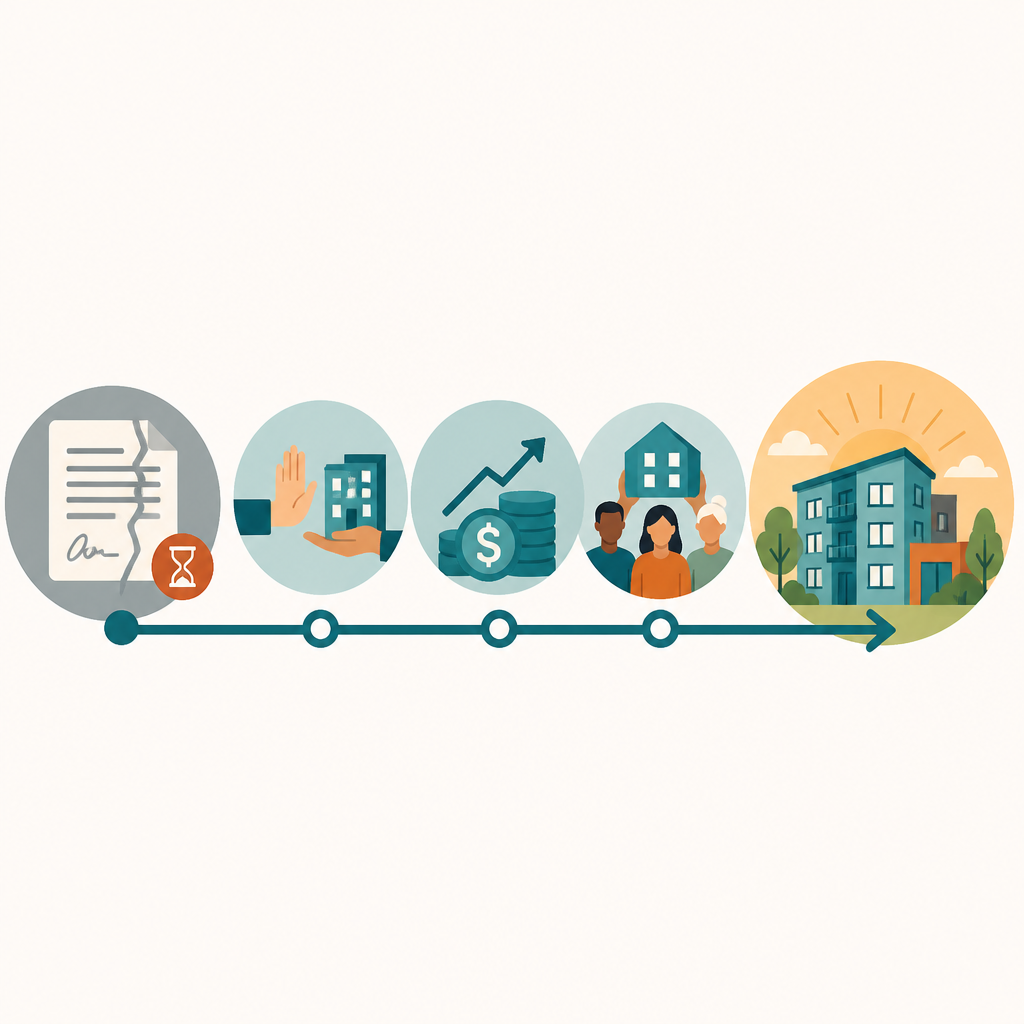
Strategies for Preserving Expiring Affordable Housing
Preservation is not a single tactic. It is a toolkit, and the right combination depends on the property, the owner's intentions, the local market, and the financing available. The strategies below are complementary, and successful preservation deals usually braid several of them together.
Right of first refusal
A right of first refusal (ROFR) gives a designated party, often a nonprofit, a tenant organization, or a public agency, the opportunity to match a third-party offer before an at-risk property can be sold to a market-rate buyer. In the LIHTC context, ROFR provisions are sometimes built into the original partnership agreements specifically to enable preservation-minded buyers to acquire the property at the end of the compliance period.
A ROFR is a powerful early-warning and access tool. It does not, by itself, supply the capital to complete a purchase, and ROFR terms can be contested. But when paired with ready financing and a capable mission buyer, it can be the mechanism that keeps a property out of speculative hands.
Closely related is the right of first offer and, at the policy level, tenant or community opportunity-to-purchase laws that some jurisdictions have adopted. These give residents or designated nonprofits a defined window and process to organize a purchase before a building goes to the open market.
Recapitalization
Many expiring properties are not just at risk of conversion; they are also physically aging and undercapitalized. Recapitalization restructures a property's financing to fund needed repairs and reset the affordability term, typically by bringing in a new round of equity, new debt, and often a fresh allocation of tax credits or other subsidy.
A well-structured recapitalization accomplishes two things at once: it addresses deferred maintenance so residents have safe, decent housing, and it locks in a new multi-decade affordability commitment. Recapitalization is frequently the financial engine behind a successful acquisition by a mission-driven buyer, because it provides the resources to both buy the property and improve it while keeping rents restricted.
Transfer to mission-driven owners
A change of ownership can be the difference between preservation and loss. Transferring an at-risk property to a mission-driven owner, a nonprofit, a community development corporation, a housing authority, a community land trust, or a resident cooperative, places the asset in the hands of an entity whose purpose is long-term affordability rather than short-term return.
Mission owners are positioned to renew subsidy contracts, accept extended affordability restrictions, and reinvest operating surplus into the property and its residents. Many of the strongest preservation outcomes combine a transfer to a mission owner with a recapitalization, so the new owner takes over a property that is both financially sound and physically improved. The challenge is usually timing and capital: mission buyers must move quickly and compete with well-funded market purchasers, which is exactly why tools like ROFR and dedicated preservation financing matter.
Converting at-risk properties to resident cooperatives
Among transfer options, conversion to a resident-owned housing cooperative is distinctive because it changes not only who owns the building but how decisions get made. In a housing cooperative, residents collectively own the property through a cooperative corporation and govern it democratically. The cooperative, not an outside landlord, controls rents, maintenance, and the property's long-term future.
For an expiring property, co-op conversion can permanently remove the unit from the speculative market. A limited-equity cooperative structure, in particular, caps the resale value of memberships so that affordability is preserved for future residents, not captured as a windfall by current ones. The result is a form of community ownership that is durable by design: there is no distant landlord whose contract can expire and no profit motive pushing toward conversion, because the people who live there are the owners.
Co-op conversion is also demanding. It requires resident organizing, governance training, acquisition financing, and a viable operating plan. The same recapitalization and transfer tools described above apply, with the resident cooperative as the receiving entity. Done well, it converts an expiration crisis into a long-term ownership opportunity for the people with the most at stake.
The policy backdrop
Preservation strategy does not operate in a vacuum; it depends on what federal programs allow. The 21st Century ROAD to Housing Act (H.R.6644), passed by Congress in June 2026 (now law as of July 2026), is significant for preservation work because its Velázquez provisions authorize housing cooperatives within federal housing programs. By making co-ops an explicitly supported ownership form in federal programs aimed at a cooperative sector already home to roughly 1.5 million families, the law strengthens the legal and financial footing for converting at-risk properties into resident-owned cooperatives, turning co-op conversion from an exception into a recognized preservation pathway.
How Built By DAO + Blueprint Fit In
Built By DAO is a venture studio for community-owned development, working across its Built By DAO, Urban Array, and Running Start Digital brands and founded by Marquis Davis. Its mission is to make community ownership of real estate practical, not just aspirational.
Blueprint, the studio's flagship platform at blueprint.builtbydao.com, is software to plan, finance, and launch affordable housing cooperatives. For preservation specifically, that means giving residents, nonprofits, and mission-driven sponsors a structured way to evaluate an at-risk property, model a recapitalization, and organize a path to resident ownership before an affordability restriction expires.
Where preservation typically stalls is in coordination and capital planning: the people closest to a building rarely have the tools to assemble a credible acquisition and financing plan on a tight timeline. Blueprint is built to compress that gap, turning the moves described above, exercising a right of first refusal, structuring a recapitalization, transferring to a mission owner, and standing up a resident cooperative, into a guided, repeatable process.
If you are facing an expiring affordable property, or you want to organize residents to own their building before a restriction lapses, explore Blueprint at blueprint.builtbydao.com to see how the planning and financing tools work.
Frequently Asked Questions
What does it mean for affordable housing to "expire"?
It means the legal restrictions that require a property to keep its rents affordable have reached their end date. Affordability is usually tied to a financing program or subsidy contract, such as LIHTC or project-based Section 8, that lasts a fixed number of years. When that term ends, the owner is generally free to raise rents to market rate or exit the program, even though the building itself remains.
What is a right of first refusal in affordable housing?
A right of first refusal gives a designated party, often a nonprofit, tenant group, or public agency, the chance to match a third-party offer before an at-risk property can be sold to a market-rate buyer. It is an access tool that helps preservation-minded buyers acquire a property, but it works best when paired with financing that is ready to close.
How does recapitalization preserve affordability?
Recapitalization restructures a property's financing, typically bringing in new equity, debt, and often a new subsidy allocation, to fund repairs and reset the affordability term. It addresses deferred maintenance and locks in a new multi-decade affordability commitment at the same time, which is why it often serves as the financial engine behind a preservation purchase.
What is a resident housing cooperative, and why does it help preservation?
In a resident housing cooperative, the people who live in a building collectively own it through a cooperative corporation and govern it democratically. For an expiring property, co-op conversion can permanently remove the homes from the speculative market, especially in a limited-equity structure that caps resale values to keep memberships affordable for future residents. Because there is no outside landlord and no profit motive pushing toward conversion, affordability is durable by design.
What did the 21st Century ROAD to Housing Act change for co-ops?
The 21st Century ROAD to Housing Act (H.R.6644), passed by Congress in June 2026, includes Velázquez provisions that authorize housing cooperatives within federal housing programs. This gives co-ops explicit standing in federal programs aimed at a cooperative sector already home to roughly 1.5 million families, strengthening the path to convert at-risk properties into resident-owned cooperatives.
Is it cheaper to preserve affordable housing or build new?
In most cases, preserving an existing affordable unit is cheaper and faster than building a new one. Expiring properties are also frequently in well-located neighborhoods near transit, jobs, and services, where new affordable construction is difficult, which makes the existing units especially valuable to keep affordable.