
A resident-owned community is one of the most durable forms of community-controlled housing in the United States. In a resident-owned communities cooperative, the people who live in a manufactured-home park or similar shared community pool their resources, form a democratic cooperative, and buy the land or building they live on. Instead of paying lot rent or rent to an outside owner who can raise prices or sell at any time, residents own the ground beneath their homes together and govern it through a one-member, one-vote cooperative.
ROCs (resident-owned communities) have grown quickly over the past two decades, especially in the manufactured-housing sector, where rising lot rents and the sale of parks to private investors have put millions of households at risk of displacement. This guide explains what ROCs are, how the resident purchase actually works, how governance and financing come together, and what the benefits and challenges look like in practice.
What Is a Resident-Owned Community?
A resident-owned community (ROC) is a neighborhood — most commonly a manufactured-home community, sometimes called a mobile home park — that is collectively owned by the residents who live there. The residents form a cooperative corporation, and that cooperative owns the underlying land, the roads, the water and sewer infrastructure, and the common areas. Each household typically becomes a member of the cooperative by purchasing a single, modestly priced membership share.
This structure solves a problem unique to manufactured housing. In a conventional park, residents usually own their homes but rent the land underneath. That split ownership leaves them vulnerable: the home is hard and expensive to move, so when a park owner raises lot rent, defers maintenance, or sells to an investor, residents have little leverage. Converting to a resident-owned cooperative gives the community control over its own land, rents, rules, and future.
ROCs are distinct from other cooperative housing models. In a limited-equity housing cooperative apartment building, members own shares tied to individual units. In a manufactured-housing ROC, members generally continue to own their individual homes outright while the cooperative owns the land in common. Both share the same democratic DNA: collective ownership, member governance, and a mission to keep housing permanently affordable.
How Residents Collectively Buy Their Community
The path from renting to owning follows a fairly consistent pattern, refined over years by national support organizations.
1. The trigger: a park goes up for sale
The most common starting point is a sale. When an owner decides to sell a manufactured-home community, residents may have an opportunity — and in a growing number of states, a legal right — to make a competing offer. Opportunity-to-purchase and right-of-first-refusal laws in states such as New Hampshire, Massachusetts, Oregon, Colorado, and others require owners to notify residents and give them a defined window to organize and bid.
2. Forming the cooperative
Residents form a cooperative corporation and elect an interim board. Most households join by buying a low-cost membership share. The cooperative — not any individual — becomes the entity that will negotiate, borrow, and ultimately hold title to the land.
3. Due diligence and the offer
With technical assistance from a nonprofit partner, the cooperative evaluates the asking price, inspects infrastructure, and projects future operating costs. Residents vote on whether to proceed. Because the group typically needs a majority of households to commit, this stage is as much about organizing neighbors as it is about real estate math.
4. Financing and closing
The cooperative secures a blend of financing (covered below), closes on the purchase, and takes ownership. From that day forward, lot fees flow to the cooperative the residents control rather than to an outside landlord.
A national network — ROC USA and its affiliated certified technical assistance providers — has helped hundreds of communities complete this conversion, demonstrating that ordinary residents, with the right support, can buy and run their own neighborhoods.
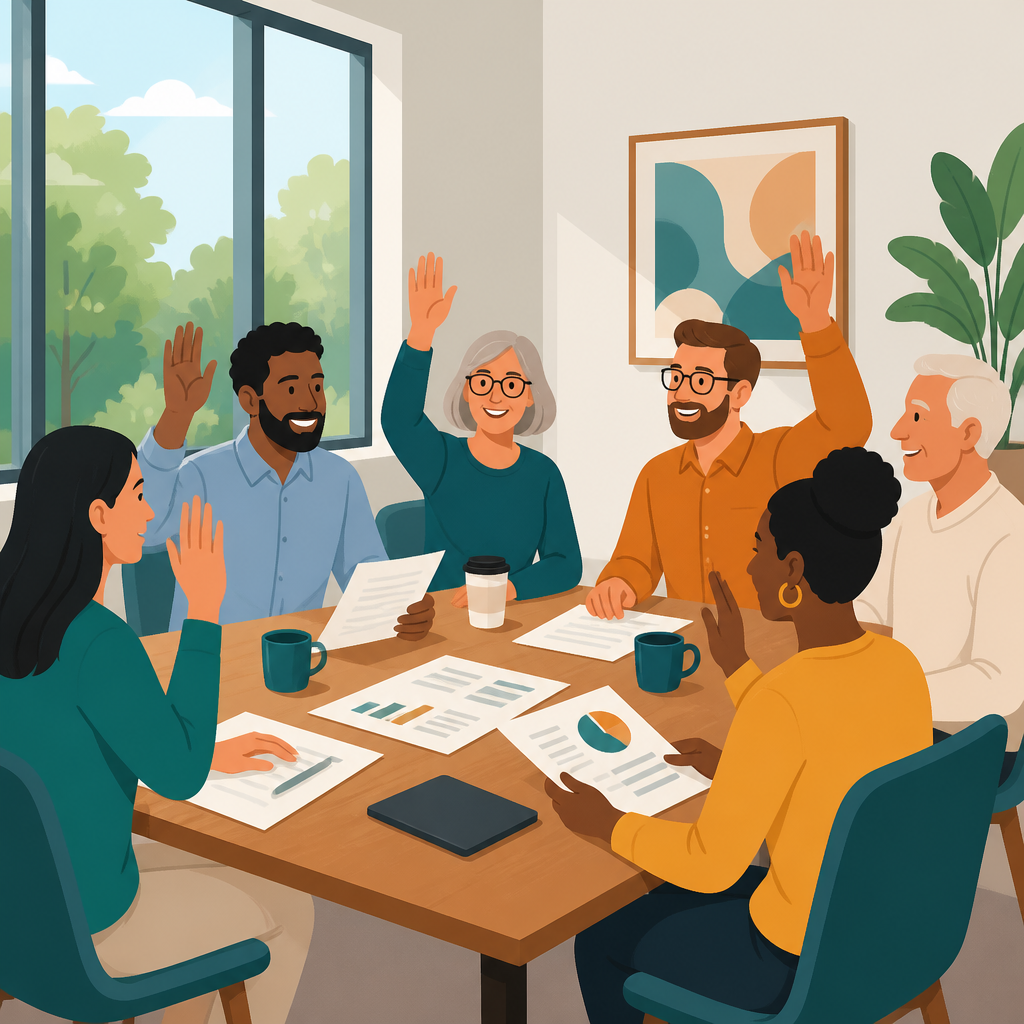
Governance: One Member, One Vote
What makes a ROC a cooperative is its governance. Resident-owned communities operate on the bedrock cooperative principle of one member, one vote, regardless of how much equity any household holds or how large their home is.
- Members elect a board of directors from among themselves.
- The board handles day-to-day decisions: setting the budget, contracting for maintenance, enforcing community rules, and planning capital improvements.
- Major decisions — approving the annual budget, changing bylaws, taking on significant debt — go to a vote of the full membership.
Most ROCs adopt bylaws and community rules that the members themselves write and can amend. Many hire a professional property manager or bookkeeper for technical tasks, but authority stays with the residents. This is a meaningful shift in power: people who were once tenants subject to a landlord's decisions become owners who set their own rules, approve their own rent, and decide how to reinvest in their community.
Good governance is also the hardest part of the ROC model. Running a multimillion-dollar property requires functional meetings, financial literacy, conflict resolution, and consistent volunteer participation. This is precisely why ongoing training and technical assistance matter so much after the purchase closes.
Financing a Resident-Owned Community
Buying a park is capital-intensive, and few cooperatives can pay cash. ROC financing typically layers several sources:
- Mission-driven mortgage debt. Community development financial institutions (CDFIs) and specialized lenders provide the bulk of the purchase price, often through a blanket loan to the cooperative secured by the land. ROC USA Capital is one well-known source built specifically for this purpose.
- Member share purchases. Each household's membership share contributes a small equity layer and signals commitment.
- Public and philanthropic gap financing. State housing finance agencies, HOME and Community Development Block Grant (CDBG) dollars, and foundation grants frequently fill the gap between what the cooperative can borrow and what the seller wants.
- Reserves. Sound deals build in replacement and operating reserves from the start, so the community can fund infrastructure repairs without emergency assessments.
Because the cooperative is nonprofit in purpose, surplus revenue is reinvested rather than extracted as profit. Over time, the loan is paid down, the community builds equity, and lot fees rise far more slowly than they would under investor ownership.
The federal tailwind
Cooperative housing finance received a significant boost in June 2026 with passage of the 21st Century ROAD to Housing Act (H.R. 6644), the most consequential federal housing affordability law since 1990. Provisions championed by Rep. Nydia Velázquez explicitly authorize and strengthen the place of housing cooperatives within federal housing programs, building on the roughly 1.5 million households already in cooperative housing. For ROCs, clearer federal recognition means cooperatives are better positioned to access established financing channels — a tailwind for the next wave of resident purchases.
The Benefits of Cooperative Ownership
Why do residents take on the work of buying and running their own community? The advantages are concrete.
- Stability and protection from displacement. Once residents own the land, no outside investor can buy the park out from under them or close it for redevelopment.
- Predictable, slower-rising costs. Cooperatives set lot fees to cover real operating costs and reserves — not to maximize an investor's return. Independent research on ROC USA communities has documented that resident-owned parks tend to see slower lot-fee growth than investor-owned parks.
- Reinvestment in the community. Surplus stays local, funding road repairs, water-system upgrades, and shared amenities.
- Wealth preservation. Stable land tenure protects the value of residents' homes, which are often their largest asset.
- Democratic voice. Members write the rules they live under and elect the neighbors who enforce them.
- Permanent affordability. Many ROCs use limited-equity or resale structures designed to keep homes affordable for the next generation of buyers.
The Challenges to Plan For
Cooperative ownership is powerful but not effortless. Communities considering a ROC should plan realistically for:
- Organizing under time pressure. Opportunity-to-purchase windows can be short, and assembling a committed majority of neighbors quickly is demanding.
- Aging infrastructure. Many parks come with deferred maintenance — failing water lines, private roads, septic systems — that the cooperative inherits and must fund.
- Governance capacity. Volunteer boards must learn to manage budgets, contracts, and conflict. Burnout and low participation are real risks.
- Financing complexity. Layering debt, member equity, and public subsidy requires technical help that not every community can easily find.
- Uneven legal protections. Opportunity-to-purchase laws exist in some states and not others, so residents' leverage varies sharply by geography.
None of these is fatal, but each underscores why technical assistance and good planning tools are essential — before, during, and long after the purchase.
How Built By DAO + Blueprint Fit In
Built By DAO is a venture studio for community-owned development. Across our ecosystem — including Urban Array's cooperative housing work in disinvested communities and Running Start Digital — we build the tools and capital pathways that make resident ownership achievable, not just aspirational.
Our flagship platform, Blueprint, is software to plan, finance, and launch affordable housing cooperatives, including resident-owned communities. Blueprint helps an organizing group model lot-fee scenarios and reserves, structure a layered financing stack, draft the cooperative governance documents members need, and manage the conversion process from first offer to closing — all in one place. For a resident group racing the clock on a park sale, that planning infrastructure can be the difference between a successful purchase and a missed window.
If your community is exploring cooperative ownership, or you support residents who are, start with Blueprint to plan, finance, and launch your resident-owned community.
Frequently Asked Questions
What does ROC stand for?
ROC stands for "resident-owned community." It refers to a manufactured-home park or other shared community that the residents collectively own and govern through a cooperative, rather than renting from an outside landlord.
How is a resident-owned community different from renting a lot in a mobile home park?
In a typical park, residents own their homes but rent the land underneath from a private owner who controls rents and rules. In a ROC, the residents' cooperative owns the land in common, so the community sets its own lot fees, writes its own rules, and cannot be sold out from under its members.
How much does it cost a resident to join a ROC?
Joining usually requires purchasing a single, low-cost membership share — often modest by design so that participation is broadly affordable. The cooperative covers the large land purchase through mortgage financing, member equity, and public or philanthropic gap funding, not through large payments from individual households.
Do I still own my home in a resident-owned community?
In manufactured-housing ROCs, yes. Members generally continue to own their individual homes outright while the cooperative owns the underlying land and shared infrastructure together. This is different from an apartment housing cooperative, where members own shares tied to specific units.
What is ROC USA?
ROC USA is a national nonprofit network that helps residents buy and run their manufactured-home communities. Through affiliated technical assistance providers and a dedicated lending arm, it has supported hundreds of resident purchases and helped standardize the conversion process nationwide.
Does the 21st Century ROAD to Housing Act help ROCs?
Yes. The law, passed in June 2026 (now law as of July 2026), includes provisions that explicitly authorize and strengthen housing cooperatives within federal housing programs. Clearer federal recognition helps resident-owned communities access established financing and support channels going forward.