
A senior housing cooperative is a residential community where older adults collectively own the building they live in through a nonprofit corporation, rather than renting from a landlord or buying a standalone unit. For people who want to age in place without watching their housing costs climb every year, this ownership model offers something rental housing rarely can: long-term cost stability, a built-in community, and a real say in how the place is run. As affordability pressures mount for adults over 55, the senior co-op is moving from a niche idea into a serious answer to one of the hardest questions in housing.
This guide explains how senior housing cooperatives actually work, what they cost, who they serve, and how recent federal policy is opening new doors for the model.
What Is a Senior Housing Cooperative?
In a senior housing cooperative, residents do not own their individual apartments outright. Instead, each household buys a share (sometimes called a membership) in the cooperative corporation that owns the entire property. Owning that share gives you the exclusive right to occupy a specific unit, plus a vote in how the cooperative is governed.
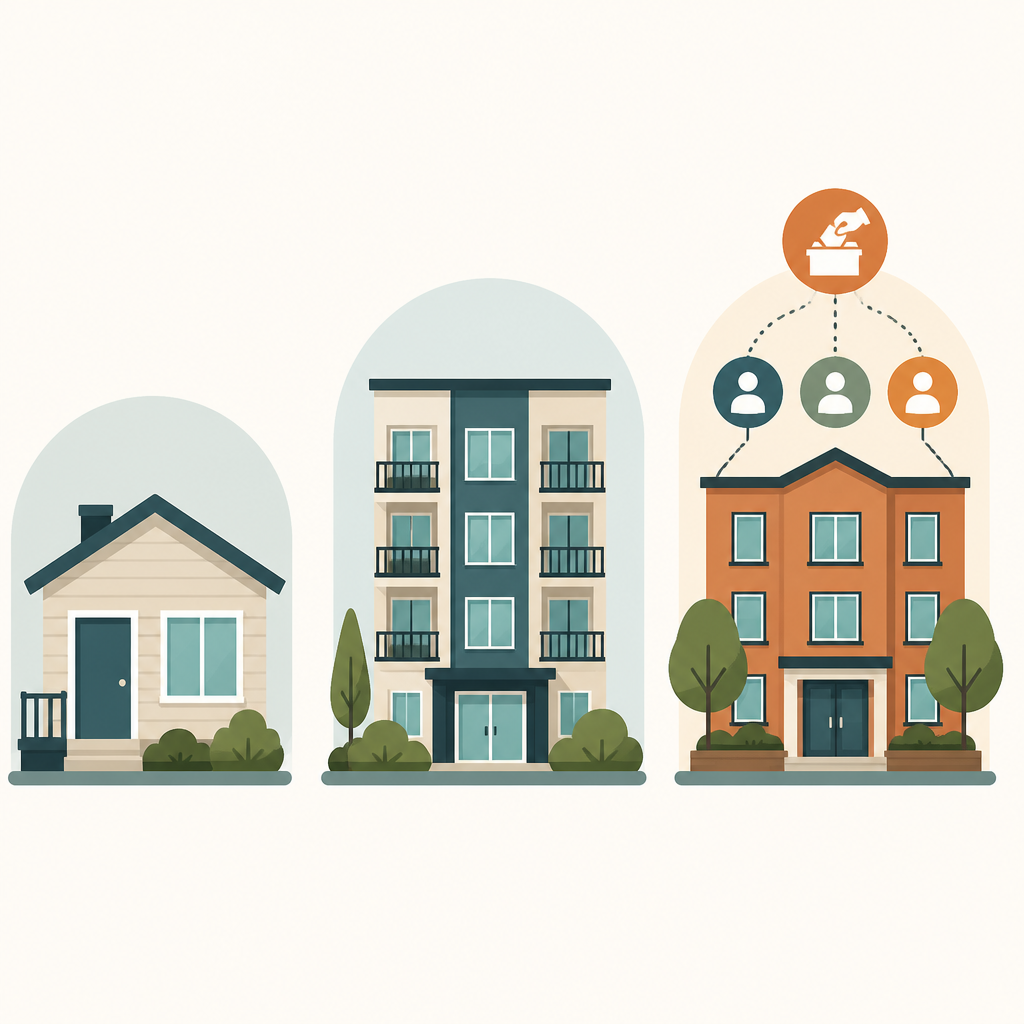
This is a different legal structure from both renting and condominium ownership:
- Renters pay a landlord and build no equity. Rent can rise with the market.
- Condo owners hold title to a specific unit and a slice of common areas, and resale prices float with the open market.
- Co-op members own a share of the corporation, and the corporation owns the real estate as a single entity.
Because the cooperative owns everything as one block, members share the underlying mortgage, taxes, and maintenance through a monthly carrying charge. Decisions are made democratically, typically one vote per unit, through an elected resident board.
Market-rate vs. limited-equity co-ops
Senior cooperatives generally fall into two families:
- Market-rate cooperatives let share values rise and fall with the housing market, similar to a condo. Members can build wealth, but entry costs are higher.
- Limited-equity cooperatives (LECs) cap how much a member's share can appreciate, often to a modest annual percentage. This intentionally keeps units affordable for the next generation of senior buyers rather than maximizing resale profit.
Limited-equity is the model most associated with affordable senior housing, because the cap on appreciation is precisely what preserves affordability over decades. Many established senior co-ops report share values rising only modestly each year, which keeps the community accessible to fixed- and moderate-income retirees.
Why Senior Co-ops Support Aging in Place
"Aging in place" means staying in your own home and community as you grow older, instead of moving into an institutional setting. Senior housing cooperatives are unusually well suited to this goal for several reasons.
Cost predictability on a fixed income
Most retirees live on relatively fixed incomes from Social Security, pensions, and savings. Housing affordability is a genuine strain for older adults: a large share of people over 50 spend more than 30% of their income on housing. Because a cooperative is member-owned and operated at cost rather than for landlord profit, monthly carrying charges tend to be more predictable than open-market rents. In limited-equity co-ops, the affordability is structural, not a temporary discount.
Built-in community reduces isolation
Aging in place in a single-family home can be lonely. Social isolation among older adults is associated with measurable declines in physical and mental health. Cooperatives are designed around shared spaces and shared governance, so neighbors know each other, look out for one another, and participate in community life by default. The result is "healthy interdependence" rather than isolation, a benefit that researchers and aging-services organizations consistently highlight when describing senior co-ops and cohousing.
Universal design and accessibility
Because a senior cooperative is purpose-built or purpose-converted for older residents, units are far more likely to include accessibility features that support aging in place, single-level living, wider doorways, grab bars, step-free entries, and elevators. These universal-design features let members stay in their homes safely as mobility needs change.
Resident control over services
A co-op board can decide collectively to add shared services, group transportation, on-site wellness programming, meal options, or contracted home-care partnerships, scaled to what members actually want and can afford. Residents are the decision-makers, not passive customers.
A Brief History and the State of the Model
Nonprofit senior housing cooperatives for residents 55 and older are not a new experiment. The first U.S. senior co-op opened in Minnesota in 1978, and the Upper Midwest remains the model's heartland. The number of senior cooperatives in the United States grew from roughly 103 in 2013 to about 125 in 2019, and the model has been expanding into new states.
That growth is meaningful, but it is also modest relative to the scale of the need. The country's population over 65 is expanding rapidly, the supply of genuinely affordable senior housing has not kept pace, and most older adults say they want to remain in their own homes and communities. Senior co-ops are one of the few ownership models that pair affordability with community and resident control, which is why advocates, lenders, and now federal policymakers are paying closer attention.
What the 2026 ROAD to Housing Act Means for Co-ops
In June 2026, Congress passed the 21st Century ROAD to Housing Act (H.R. 6644) (now law as of July 2026), the largest housing affordability law since 1990.
For the cooperative housing world, the most consequential pieces are the Velázquez provisions, which explicitly authorize housing cooperatives within federal housing programs. Historically, many federal housing programs were written around conventional rental and single-family ownership, leaving cooperatives in an ambiguous position that complicated financing and program eligibility. Naming cooperatives explicitly in the statute is a structural fix: it signals to lenders, agencies, and developers that co-ops are a recognized, fundable form of housing rather than an exception that has to be argued for case by case.
The law's cooperative provisions are aimed at a cooperative sector already home to 1.5 million families through cooperative housing. For seniors specifically, clearer federal authorization can make it easier to finance new senior co-op developments, convert existing properties into limited-equity cooperatives, and combine cooperative ownership with other affordable-housing tools. In short, the model that has grown slowly for four decades now has firmer federal footing under it.
It is worth being precise about what the law does and does not do. It does not guarantee that any particular co-op gets built or funded; it removes barriers and creates authority. The hard work of planning, financing, and launching a cooperative still falls to communities and the people who help them organize. That is exactly the gap this next section addresses.
How Built By DAO + Blueprint Fit In
Built By DAO is a venture studio focused on community-owned development. Founded by Marquis Davis, the studio builds tools and ventures that put ownership in the hands of residents rather than distant landlords. Its housing-focused brand, Urban Array, develops cooperative housing in communities that have faced disinvestment, and Running Start Digital supports the broader ecosystem.
The studio's flagship product is Blueprint (blueprint.builtbydao.com), software built to plan, finance, and launch affordable housing cooperatives. Standing up a senior housing cooperative is genuinely complex: you have to assemble a member group, structure the cooperative corporation, model carrying charges, line up financing, and navigate program eligibility, the kind of work that the ROAD to Housing Act has now made more viable but no less detailed. Blueprint exists to make that path navigable, walking organizers through the planning, financial modeling, and launch steps that turn a group of interested seniors into an operating cooperative.
If you are exploring a senior co-op, whether you are a group of older neighbors who want to age in place together, a nonprofit, or a developer serving an aging community, Blueprint is designed to be your starting point.
Ready to plan a cooperative? Start with Blueprint.
Frequently Asked Questions
How is a senior housing cooperative different from renting?
When you rent, you pay a landlord, build no equity, and your rent can rise with the market. In a senior housing cooperative, you buy a share in the corporation that owns the building, which gives you the right to occupy your unit and a vote in governance. The cooperative is run at cost rather than for landlord profit, which tends to make monthly costs more predictable, and in limited-equity co-ops, affordability is preserved by design.
Do I build equity in a senior co-op?
It depends on the type. In a market-rate cooperative, your share value can rise and fall with the housing market, similar to a condo. In a limited-equity cooperative, appreciation is intentionally capped, often to a small annual amount, so the unit stays affordable for the next senior buyer. Limited-equity co-ops trade maximum wealth-building for long-term affordability and stability.
Are senior housing cooperatives only for low-income seniors?
No. Cooperatives span a range from market-rate to deeply affordable. Limited-equity cooperatives are the model most associated with affordable senior housing because their appreciation caps keep prices accessible, but co-ops as a whole serve fixed-income, moderate-income, and market-rate residents depending on how each cooperative is structured.
What does the 21st Century ROAD to Housing Act change for senior co-ops?
The act, passed by Congress in June 2026, includes Velázquez provisions that explicitly authorize housing cooperatives within federal housing programs. This gives co-ops clearer standing for financing and program eligibility, which can make it easier to develop new senior cooperatives or convert existing properties. The cooperative provisions are aimed at a cooperative sector already home to roughly 1.5 million families.
How do residents make decisions in a co-op?
Cooperatives are governed democratically, typically one vote per household. Members elect a resident board that oversees the budget, maintenance, and shared services. This resident control is part of what lets senior co-ops tailor services, accessibility upgrades, and community programming to what their members actually want and can afford.
How do I start a senior housing cooperative?
Starting a co-op involves organizing a member group, forming the cooperative corporation, modeling carrying charges, securing financing, and navigating program rules. With cooperatives now more firmly recognized in federal housing law, the path is more viable than before. Tools like Blueprint from Built By DAO are built specifically to guide organizers through planning, financing, and launching an affordable housing cooperative.