
If you have followed the affordable housing debate over the past few years, you have probably run into the phrase "social housing" and wondered how it differs from the public housing most Americans already know. This is social housing explained in plain language: what it is, where it works, how a growing US movement is adapting it, and why cooperatives and other forms of community ownership keep showing up at the center of the conversation.
Social housing is not a single program. It is a broad category of housing that is removed, partly or fully, from the speculative market and operated to serve residents rather than to maximize profit. The defining features are usually durable affordability, public or nonprofit ownership or stewardship, and resident security of tenure. Beyond that, the specifics vary enormously from country to country and, increasingly, from one American jurisdiction to the next.
What "social housing" actually means
The clearest way to understand social housing is to start with what it is trying to fix. In a purely market system, housing is a commodity. Its price is set by what buyers and renters will pay, which means that in high-demand cities, rents and prices climb until large numbers of working people are squeezed out. Social housing intervenes by taking some homes off that speculative treadmill and committing them to long-term affordability.
Three ideas recur across nearly every social housing model:
- Decommodification. Homes are insulated from market resale and rent pressures, often permanently, through public ownership, nonprofit stewardship, deed restrictions, or limited-equity structures.
- Mixed incomes. Many of the most admired systems deliberately house a wide income range together, rather than concentrating only the lowest-income households. This is a sharp break from how much US public housing was built.
- Resident security and voice. Tenants and members typically have strong protections against displacement and, in cooperative models, a formal say in how their housing is governed.
These principles can be delivered through public agencies, mission-driven nonprofits, limited-equity cooperatives, community land trusts, or hybrids of all of the above. That flexibility is a strength, but it is also why the term confuses people.
The international models
The international examples that shape the US conversation are worth understanding on their own terms, because Americans tend to import the headline ("Vienna!") without the underlying mechanics.
Vienna, Austria
Vienna is the most cited example of social housing done at scale. A large share of the city's residents live in housing that is either owned directly by the city or built and operated by limited-profit housing associations. Crucially, this housing is not means-tested down to only the poorest households; broad swaths of the middle class are eligible, which keeps the system politically durable and socially mixed.
Vienna's model rests on a few pillars that are hard to replicate quickly: a century of sustained public investment, large municipal land holdings, a regulated limited-profit development sector, and subsidy systems that reward quality and cost control. The lesson most US advocates draw is not "copy Vienna's buildings" but "build the institutions and land base that make permanently affordable, mixed-income housing normal rather than exceptional."
Singapore
Singapore takes a very different route to a related goal. Through its Housing and Development Board, the government has built the overwhelming majority of the country's housing stock, and most residents own their flats on long leases. It is a homeownership-centered model delivered through a dominant public developer, paired with mandatory savings and tight control of land.
Singapore is often cited to make a simple point: a public developer operating at scale can house most of a society. The tradeoffs — strong state control of land, restrictions on resale, and a system tightly woven into national policy — also make clear that the model is not a plug-and-play template for the decentralized, market-driven US context. Still, the idea of a competent, mission-driven public builder has clearly influenced the American movement.
How social housing differs from traditional US public housing
This is the distinction that trips people up most, so it deserves its own section.
Traditional US public housing, built largely in the mid-twentieth century, was generally deeply means-tested (reserved for the lowest-income households), owned and operated by local housing authorities, and chronically underfunded by federal appropriations. Concentrating poverty in physically isolated developments, combined with decades of disinvestment, gave "public housing" a troubled reputation in the public imagination, fairly or not.
The newer social housing approach tries to learn from that history:
- Mixed incomes instead of concentrated poverty. Cross-subsidy from higher-income units helps fund the building and dilutes the stigma.
- Financial self-sustainability instead of annual appropriations. Many proposals aim for projects that cover their operating costs and reinvest surpluses, reducing dependence on uncertain budgets.
- Broader ownership and stewardship structures. Instead of a single housing authority, social housing may run through public developers, nonprofits, cooperatives, or land trusts.
In short, "public housing" describes a specific, largely federal program with a specific history. "Social housing" is the broader, forward-looking category that includes new public ownership models but also nonprofit and cooperative forms. The two overlap, but they are not synonyms.
The emerging US social housing movement
For most of the last few decades, US affordable housing policy ran mainly through the Low-Income Housing Tax Credit and tenant-based vouchers — tools that lean heavily on private developers and landlords. The social housing movement is an attempt to add a different lever: housing that is publicly or collectively owned and permanently off the speculative market.
Montgomery County, Maryland
Montgomery County is the example US advocates point to most. Its Housing Opportunities Commission established a revolving fund used to finance and co-develop mixed-income apartment buildings in which the public entity holds a long-term ownership stake. The idea is to use public financing to get projects built, retain public ownership for lasting affordability and cross-subsidy, and recycle proceeds into the next project. It is frequently described as a US adaptation of the Vienna logic, scaled to what a single county can do.
Social housing developers and public developers
Beyond Montgomery County, a wave of state and city proposals has pushed to create public developers or social housing developers — public or quasi-public entities chartered to build and own mixed-income, permanently affordable housing directly, rather than only subsidizing private builders. Voters and legislators in several jurisdictions have advanced ballot measures and bills to establish such entities and fund them. The details differ, but the through-line is the same: a durable public or nonprofit owner that keeps homes affordable across generations.
It is worth being candid that this movement is young. Many of these entities are newly created, their pipelines are small relative to overall housing need, and their long-term financial performance is still being proven. Supporters see early, promising models; skeptics want to see results at scale before declaring success. Both can be true at once.
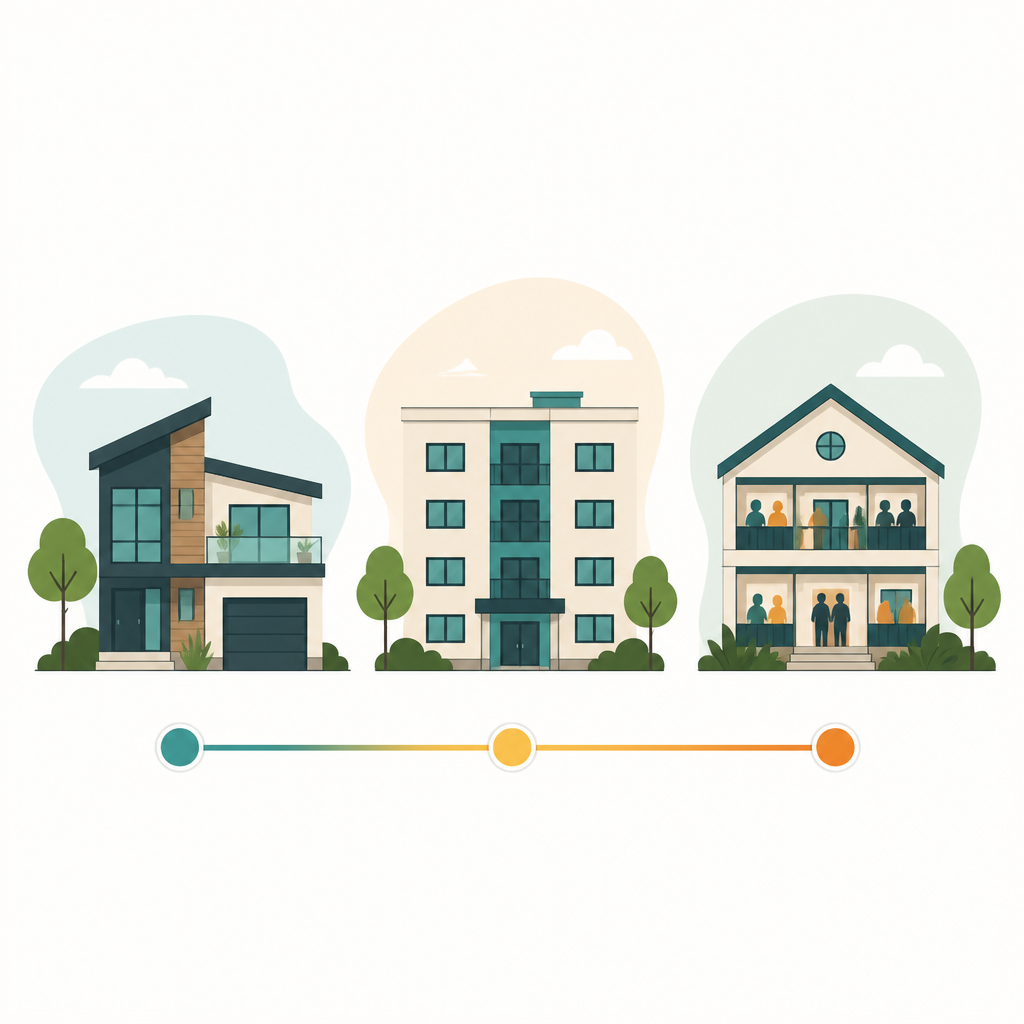
Where cooperatives and decommodified ownership fit
Cooperatives are one of the oldest and most resident-centered forms of social housing, and they fit squarely inside the decommodification idea. In a housing cooperative, residents collectively own and govern their housing through a corporation in which each household holds a membership. Limited-equity cooperatives cap the resale value of a member's share, which keeps the homes affordable for the next member instead of letting them appreciate to market rates. That cap is precisely what makes the affordability permanent.
Cooperatives occupy a distinctive middle ground:
- More ownership and control than renting. Members govern the building democratically and enjoy strong security of tenure.
- More affordability protection than conventional homeownership. Equity caps and shared ownership keep prices anchored below the speculative market.
- A community-owned, not state-owned, structure. This appeals to people who want decommodified housing without a purely government landlord.
Community land trusts, which separate ownership of the land from ownership of the homes on it, work toward the same end through a different mechanism and often pair well with cooperatives. Together, these models give the social housing movement options beyond the binary of "government-owned" versus "market-rate."
The honest debates
A page that only sells one side is not useful, so here are the real tensions, presented fairly.
Cost and subsidy. Building or acquiring housing and keeping it permanently affordable requires substantial upfront capital. Critics argue the per-unit cost can be high and that the same dollars might serve more households through vouchers. Supporters counter that vouchers do not build new supply or guarantee permanent affordability, and that public ownership captures long-term value rather than paying it to private landlords forever.
Scale and speed. Market-rate and tax-credit development can move faster in many places. Social housing institutions take time to build, and land acquisition in expensive cities is hard. The counterargument is that durable institutions and land banks pay off over decades, exactly as Vienna's did.
Governance and management. Cooperatives and public developers require competent governance. Co-ops depend on engaged members; public developers depend on capable agencies. Poorly run examples exist on every side of housing policy, which is why tooling, training, and transparent operations matter.
Homeownership versus permanent affordability. Limited-equity structures trade away the wealth-building upside of conventional homeownership in exchange for stability and affordability. For some households that is a welcome deal; for others it is a real sacrifice. Reasonable people weigh it differently.
None of these debates is settled. The movement is strongest when it engages them honestly rather than promising that social housing is free or frictionless.
How Built By DAO + Blueprint fit in
Built By DAO is a venture studio for community-owned development. Our flagship product, Blueprint, is software that helps community groups, nonprofits, and emerging public and cooperative developers plan, finance, and launch affordable housing cooperatives — the decommodified, resident-governed model at the heart of this article.
The reason this matters now is policy as much as software. The 21st Century ROAD to Housing Act (H.R.6644), passed by Congress in June 2026 (now law as of July 2026), includes Velázquez provisions that authorize cooperatives within federal housing programs. Those provisions are expected to support roughly 1.5 million families through cooperative housing — a meaningful expansion of the legal and financial pathways for the exact models we have described here. When cooperatives become a first-class option inside federal programs, the bottleneck shifts from "is this allowed" to "can a community actually structure, finance, and operate it." That second problem is the one Blueprint is built to solve.
If you are a community organization, a cooperative founder, or a public or social housing developer trying to turn the ideas in this article into real buildings, that is precisely what we build for.
Explore Blueprint and start planning your housing cooperative →
Frequently asked questions
Is social housing the same as public housing?
No. Public housing usually refers to the specific, largely federally funded program of housing owned by local housing authorities and reserved for very low-income households. Social housing is the broader category — it includes new public ownership models but also nonprofit, cooperative, and land-trust forms, and it often deliberately houses mixed incomes rather than concentrating poverty.
Why do advocates point to Vienna and Singapore?
Vienna shows that permanently affordable, mixed-income housing can become a normal option for a large share of a city's residents when there is sustained public investment, a public land base, and a regulated limited-profit sector. Singapore shows that a competent public developer can house most of a society. Both are cited for their institutions and scale, not as templates to copy detail-for-detail into the very different US context.
What is a limited-equity housing cooperative?
It is a cooperative in which residents collectively own and govern their housing, but the resale value of each member's share is capped. The cap is what keeps the homes affordable for future members instead of allowing prices to rise to market rates. Members get strong security and democratic control while trading away some of the wealth-building upside of conventional homeownership.
What is a public developer or social housing developer?
It is a public or quasi-public entity chartered to build and own mixed-income, permanently affordable housing directly, rather than only subsidizing private builders. Several US states and cities have moved to create such entities. Montgomery County, Maryland, is the most-cited early adaptation of this approach.
How does the 21st Century ROAD to Housing Act affect cooperatives?
The 21st Century ROAD to Housing Act (H.R.6644), passed by Congress in June 2026, includes Velázquez provisions that authorize cooperatives within federal housing programs and are expected to support around 1.5 million families through cooperative housing. In practical terms, it broadens the legal and financial pathways for communities to use the cooperative model.
How does Built By DAO help communities build social housing?
Built By DAO's Blueprint software helps community groups, nonprofits, and emerging developers plan, finance, and launch affordable housing cooperatives. It is designed to take the structuring, financial modeling, and launch work that usually requires specialized expertise and make it accessible to the communities that want to own their housing.