
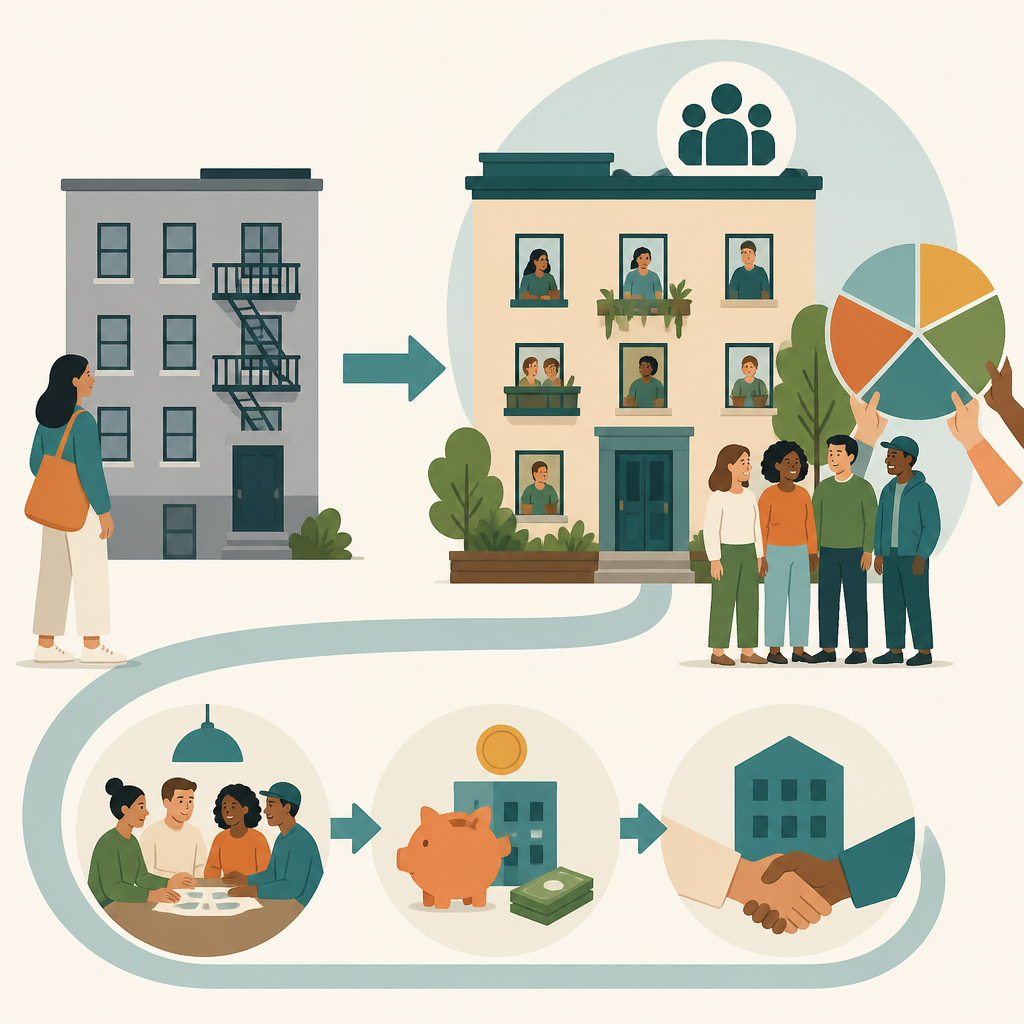
A tenant to owner conversion cooperative is one of the most direct paths a group of renters has to stop paying a landlord and start owning the building they already live in. When a rental property is sold or refinanced, the tenants form a cooperative corporation, collectively buy the building, and become member-owners instead of leaseholders. With the passage of the 21st Century ROAD to Housing Act (H.R. 6644) in June 2026 — the largest housing affordability law since the 1990 Cranston-Gonzalez National Affordable Housing Act — cooperatives are now explicitly authorized within federal housing programs, which removes a structural barrier that conversions have struggled with for decades.
This guide explains how renters convert a building into a co-op, how right-of-first-refusal laws like TOPA create the legal window to do it, what the conversion process actually involves, how the deal gets financed, and the pitfalls that derail conversions before they close.
What a tenant-to-owner conversion is (and isn't)
In a conversion, the tenants of an existing rental building come together, form a cooperative housing corporation, and purchase the building from its current owner. After closing, the corporation owns the real estate. Each household holds a membership share and a proprietary lease (sometimes called an occupancy agreement) that gives them the exclusive right to occupy their unit and a vote in how the building is run.
This is different from buying a condo. In a condominium, each owner holds title to an individual unit. In a cooperative, the corporation owns the whole building and members own shares in the corporation. That single-entity structure is what makes co-ops well suited to affordable conversions: the building can carry one blanket mortgage, members share operating costs, and resale terms can be controlled.
Most affordable conversions use a limited-equity cooperative (LEC) structure. In an LEC, the price a member can charge when they sell their share is capped by a formula in the bylaws. This keeps the homes permanently affordable for the next buyer instead of letting early members cash out at market rates and price out future residents. Members build modest equity and pay below-market monthly carrying charges, but the building stays affordable across generations.
How right-of-first-refusal and TOPA create the opening
Tenants can only convert a building when they have the legal right and the time to make an offer. That is what tenant opportunity-to-purchase laws provide.
The Tenant Opportunity to Purchase Act (TOPA), pioneered in Washington, D.C., is the model most people reference. When an owner decides to sell a residential building, TOPA requires them to give tenants formal notice and a right of first refusal — the chance to match a bona fide third-party offer or negotiate their own purchase before the building is sold to an outside buyer. The law gives tenants a defined window to organize, form an association, and either buy the building themselves or assign their rights to a partner who will preserve affordability.
Several states and cities have adopted similar frameworks. Some grant a true right of first refusal (match the offer), others a right of first offer (negotiate first), and some apply only to buildings above a certain unit count or to specific triggers such as expiring affordability covenants or planned demolition. The mechanics vary, so the first step in any conversion is to confirm exactly what rights apply where the building sits.
What changes under the 2026 ROAD to Housing Act is the destination. Historically, tenants who exercised these rights often struggled to route the deal through federal financing because cooperatives sat in a gray area of program eligibility. The Velázquez provisions in the new law explicitly authorize housing cooperatives within federal housing programs and are aimed at a cooperative sector already home to roughly 1.5 million families. That clarity makes it far more realistic for a tenant group to use a right-of-first-refusal window and then actually close with federally backed financing behind a co-op.
The conversion process, step by step
Every conversion is different, but the path generally moves through the following stages.
1. Organize the tenants
Nothing happens without a critical mass of committed households. Successful conversions usually need a clear majority of residents willing to participate and pay carrying charges. This stage is about building an association, electing leadership, holding meetings, and getting honest about who can and will buy in.
2. Trigger or respond to the purchase right
If the owner has issued a sale notice under TOPA or a similar law, the clock is already running and the tenant association must respond within the statutory window. If no sale is pending, tenants can still approach the owner directly to negotiate a purchase, though they lose the leverage that a forced right-of-first-refusal provides.
3. Form the cooperative corporation
The group incorporates a cooperative housing corporation and drafts bylaws, a proprietary lease or occupancy agreement, and — for affordability — limited-equity resale formulas. This is where decisions about governance, share pricing, and who qualifies for membership get locked in. Legal counsel experienced in co-op conversions is essential here.
4. Conduct due diligence
The cooperative orders a building inspection, an engineering or capital-needs assessment, an appraisal, a title search, and a review of the building's finances. Deferred maintenance is the silent budget-killer of conversions; the capital-needs assessment tells the group what repairs are coming and what they will cost over the next 20 years.
5. Structure the financing
The cooperative assembles a capital stack: a blanket first mortgage, member share purchases (down payments), and often subsidy or grant layers to close the affordability gap. See the financing section below.
6. Negotiate and close
The cooperative and seller agree on price and terms, the financing commitments are finalized, and the deal closes. Title transfers to the cooperative corporation, and tenants sign proprietary leases as member-owners.
7. Operate and govern
After closing, the real work begins: the member-elected board manages the building, sets carrying charges, maintains reserves, and enforces the bylaws. A conversion that closes but is governed poorly can still fail. Strong reserves and competent management are what keep a co-op solvent.
Financing a conversion
Financing is usually the hardest part of a tenant-to-owner conversion, because the building has to be paid for at roughly market value while keeping monthly costs affordable for residents who often have modest incomes. The capital comes from several layers stacked together.
- Blanket first mortgage. The cooperative corporation takes out a single mortgage covering the entire building. Carrying charges paid by members cover the debt service, taxes, insurance, maintenance, and reserves. With cooperatives now explicitly eligible under the ROAD to Housing Act's Velázquez provisions, more federal mortgage and credit-enhancement programs can sit behind these loans.
- Member share purchases. Each member buys a share, which functions like a down payment. In limited-equity co-ops these are kept intentionally low — often a few thousand dollars rather than a conventional 20% down payment — to keep entry affordable.
- Subsidy and gap financing. Most affordable conversions cannot pencil out on debt and shares alone. They layer in city or state housing trust funds, HOME or CDBG funds, soft second loans, philanthropic capital, or community development financial institution (CDFI) loans to bridge the gap between what the building costs and what residents can carry.
- Predevelopment funding. Appraisals, inspections, legal fees, and organizing take money before a deal closes. Predevelopment grants and loans from housing intermediaries fund this early work so a tenant group is not asked to pay out of pocket for due diligence.
The financial test that matters is whether projected carrying charges — covering debt, operations, and a properly funded reserve — stay affordable to the existing residents. If they do not, the deal needs more subsidy or a lower purchase price, not optimistic budgeting.
Common pitfalls that derail conversions
- Underfunded reserves. The most common long-term failure. A co-op that buys an older building without budgeting for the roof, boiler, and systems it will inevitably replace will face special assessments residents cannot afford.
- Skipping the capital-needs assessment. Buying without a clear picture of deferred maintenance is how groups inherit six-figure repair surprises.
- Weak participation. If too few households commit, carrying charges per unit rise and the math breaks. Conversions need broad, durable buy-in.
- Missing the statutory window. Tenant purchase rights come with deadlines. Miss the notice period and the building can be sold out from under the group.
- Governance gaps. A cooperative is a small business. Without training, clear bylaws, and competent management, member-owned buildings can drift into dysfunction.
- No affordability lock. Converting without a limited-equity resale formula lets early members eventually sell at market rates, defeating the purpose of a community-owned conversion.
How Built By DAO + Blueprint fit in
Built By DAO is a venture studio for community-owned development. Our ecosystem — including Urban Array, which develops cooperative housing in disinvested communities — exists to make tenant-to-owner conversions and new co-op development achievable for the people who actually live in these buildings, not just well-capitalized institutions.
Our flagship platform, Blueprint, is software to plan, finance, and launch affordable housing cooperatives. For a tenant group facing a TOPA-style window, Blueprint helps model carrying charges, structure the capital stack, organize members, and walk through the conversion steps without needing a developer's back office on day one. Urban Array and Blueprint are built to support exactly the kind of right-to-purchase conversions the new ROAD to Housing Act makes more viable.
If your building has received a sale notice, or you want to understand whether a conversion could work where you live, start planning with Blueprint: blueprint.builtbydao.com.
Frequently asked questions
What is a tenant-to-owner conversion cooperative?
It is a process where the renters in an existing building form a cooperative corporation, buy the building together, and become member-owners. Each household holds a membership share and a proprietary lease instead of a standard rental lease, and the corporation owns the real estate.
Do tenants have a legal right to buy their building?
It depends on local law. Jurisdictions with tenant opportunity-to-purchase laws like TOPA give renters notice and a right of first refusal when the owner decides to sell. Where no such law exists, tenants can still negotiate a purchase directly but without the leverage of a guaranteed window. Confirm what rights apply to your specific building.
How does the new ROAD to Housing Act help?
The 21st Century ROAD to Housing Act (H.R. 6644), passed in June 2026 (now law as of July 2026), includes Velázquez provisions that explicitly authorize housing cooperatives within federal housing programs and are aimed at a cooperative sector already home to roughly 1.5 million families. That clears up long-standing eligibility ambiguity, making it more practical to finance a co-op conversion with federally backed programs.
What is a limited-equity cooperative?
A limited-equity cooperative (LEC) caps how much a member can sell their share for, using a formula in the bylaws. This keeps the homes affordable for future buyers rather than letting early members cash out at market rates, which is why most affordable conversions use the LEC structure.
How is a conversion financed?
Through a stacked capital structure: a blanket first mortgage on the building, modest member share purchases that act as down payments, and subsidy or gap financing from sources like housing trust funds, soft loans, philanthropy, or CDFIs. The goal is to keep monthly carrying charges affordable for existing residents.
What most often causes a conversion to fail?
Underfunded reserves and skipped capital-needs assessments are the leading causes of long-term failure, followed by weak resident participation, missed statutory deadlines, and poor governance after closing. Strong reserves, broad buy-in, and competent management are what keep a converted co-op solvent.