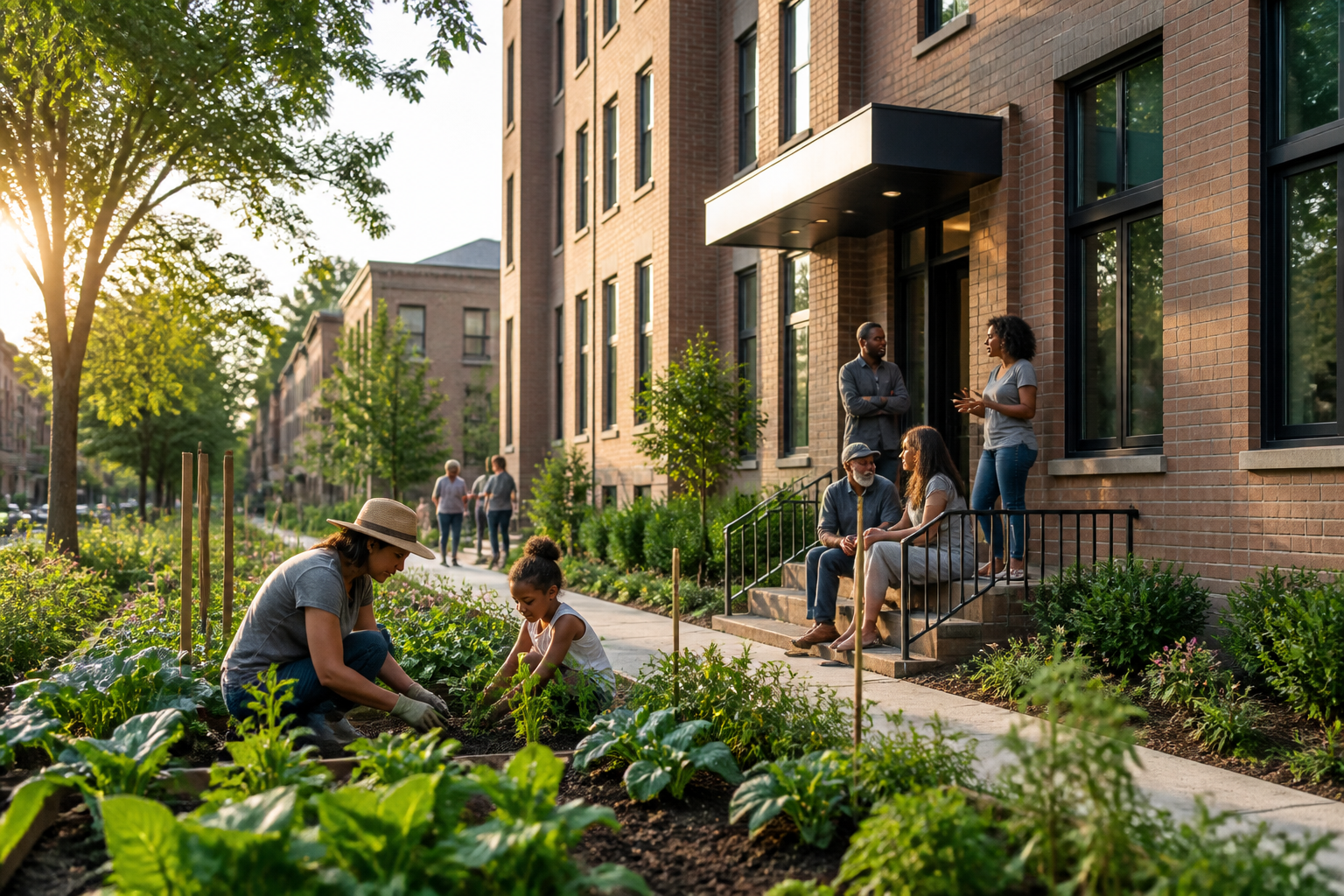
Cooperative housing in disinvested neighborhoods offers a different answer to a familiar problem. For decades, the standard response to vacant lots and deteriorating buildings has been to wait for outside capital to arrive, redevelop, and ultimately raise rents until the people who held the block together can no longer afford to stay. Urban Array, the on-the-ground development arm within the Built By DAO ecosystem, was created to break that cycle. Its model takes the parcels that disinvestment left behind and converts them into housing that the residents themselves own and govern, so that the value created by recovery stays in the community that earned it.
This page explains how the Urban Array model works, why cooperative ownership is well suited to neighborhoods that have endured decades of underinvestment, and how the platform tools built within the ecosystem make the approach repeatable rather than exceptional.
Why Disinvested Neighborhoods Need a Different Model
Disinvestment is rarely an accident. Redlining, predatory lending, deferred maintenance, tax foreclosure, and speculative land banking compound over time until a neighborhood is full of vacant parcels and absentee-owned buildings. The people who remain are often long-tenured renters with deep local knowledge and few ownership options. When recovery finally comes, it usually arrives as conventional development that treats existing residents as obstacles to be priced out rather than partners to be invested in.
The Urban Array model starts from the opposite premise. The residents and the surrounding community are the development partners. The goal is not simply to add housing units but to change who holds the equity, who makes decisions, and who benefits when property values recover. That reframing is what makes cooperative ownership central to the approach.
The Limits of Conventional Affordable Housing
Traditional affordable housing programs do real good, but most of them preserve a landlord-tenant relationship. Tenants gain a below-market rent for a period of time, yet they accumulate no equity, hold no governance rights, and remain exposed to the expiration of affordability covenants. When subsidies lapse or buildings are sold, affordability can evaporate. Cooperative ownership addresses the structural gap by giving residents a durable stake and a permanent seat at the table.
How the Urban Array Model Works
The model follows a deliberate sequence. Each stage is designed to keep ownership and decision-making anchored in the neighborhood.
1. Acquisition of Disinvested Property
Urban Array focuses on the parcels and buildings that the market has written off: vacant lots, tax-delinquent properties, distressed multifamily buildings, and underused land in neighborhoods with strong community fabric but weak access to capital. Acquiring these properties early, before speculative interest drives prices up, keeps the cost basis low enough to support permanent affordability. Low acquisition cost is not incidental to the model; it is the foundation that makes resident ownership financially viable.
2. Community Engagement First
Before development plans are finalized, the model prioritizes listening. Residents, neighborhood associations, faith institutions, and local businesses help define what the project should become. This is not a public-relations exercise. The people who will live in and around the housing shape the unit mix, the shared spaces, the ground-floor uses, and the governance structure. Engagement builds the trust and participation that a cooperative depends on, because a co-op only works if its members are genuinely invested in running it.
3. Cooperative Formation
The defining feature of the model is that residents become member-owners rather than tenants. Depending on the project, this can take the form of a limited-equity housing cooperative, in which members buy an affordable share, build modest equity over time, and govern the property democratically on a one-member-one-vote basis. Limited-equity structures are intentional: they let members accumulate real wealth while keeping resale prices restricted so that the homes remain affordable for the next generation of members. Ownership is shared, permanent, and rooted locally.
4. Mixed-Income by Design
The model is built to support a range of household incomes rather than concentrating poverty or, at the other extreme, displacing existing residents through uniform market-rate pricing. A deliberate income mix strengthens the financial resilience of each cooperative, supports stable operating budgets, and reflects the actual diversity of the neighborhoods Urban Array works in. Mixed-income cooperatives can welcome the longtime resident, the essential worker, and the young family on the same democratic terms.
5. Neighborhood Wealth-Building
The ultimate measure of the model is whether wealth stays and grows in the community. Because members hold equity, share in governance, and control the asset collectively, the recovery of property value benefits residents instead of outside investors. Cooperatives also tend to anchor further reinvestment: stable, owner-occupied buildings support local businesses, reduce vacancy and blight, and give neighbors a reason and a vehicle to keep building. One cooperative can become the seed of a broader, resident-led recovery rather than a one-off project.

The Cooperative Advantage in Practice
Cooperative housing is not a new idea, but applying it systematically in disinvested neighborhoods requires solving several hard problems at once: financing, legal structure, member readiness, and long-term governance. The Urban Array model treats these not as obstacles to work around but as the core work itself.
- Permanent affordability. Resale restrictions and shared ownership keep homes affordable across generations rather than for a fixed subsidy window.
- Democratic control. One-member-one-vote governance gives residents real power over their housing, from budgets to maintenance to long-term planning.
- Equity for residents, not extractors. Members build modest, meaningful wealth, and appreciation is shared rather than captured by distant owners.
- Stability that compounds. Owner-occupancy reduces turnover and disinvestment, which in turn supports schools, small businesses, and civic life.
These advantages are why the broader policy landscape is increasingly making room for cooperatives, and why the timing for the model is unusually favorable.
A Policy Tailwind: The 21st Century ROAD to Housing Act
In June 2026, the 21st Century ROAD to Housing Act (H.R. 6644) became the most significant housing affordability law since 1990. Among its provisions, the Velázquez language explicitly authorizes housing cooperatives within federal housing programs, with co-op provisions aimed at a cooperative sector already home to roughly 1.5 million families.
For a model like Urban Array's, this matters in a concrete way. Federal recognition of cooperatives expands the toolkit available to convert disinvested property into resident-owned housing: more financing pathways, clearer program eligibility, and a national signal that cooperative ownership is a legitimate, scalable form of affordable housing rather than a niche experiment. The bill does not build anything on its own, but it widens the road that the Urban Array model already travels.
How Blueprint Powers the Model
Turning the Urban Array approach into something repeatable across many neighborhoods requires more than goodwill. It requires software that can carry the complexity of planning, financing, and launching a housing cooperative end to end. That is what Blueprint, the flagship platform built within the Built By DAO ecosystem, is designed to do.
Blueprint helps organizers, residents, and developers move a cooperative from idea to reality. It supports the work of mapping parcels and acquisition strategy, modeling mixed-income financing scenarios, structuring limited-equity cooperatives, organizing member readiness, and managing the governance and documentation a co-op needs to launch and operate. By packaging hard-won expertise into a tool, Blueprint lowers the barrier that has historically kept cooperative development limited to well-resourced organizations. The goal is to make the next cooperative easier to launch than the last one, so the model can scale to the neighborhoods that need it most.
If you are organizing residents, working in community development, or planning to convert disinvested property into resident-owned housing, explore how the platform can support your project.
Start planning your cooperative with Blueprint →
Frequently Asked Questions
What is a housing cooperative, and how is it different from renting?
A housing cooperative is a property owned collectively by the people who live in it. Instead of paying rent to a landlord, residents become member-owners: they hold a share in the cooperative, vote on decisions democratically, and have a permanent stake in the building. Unlike renting, cooperative membership builds equity and gives residents lasting control over their housing.
What is a limited-equity cooperative?
A limited-equity cooperative lets members buy an affordable share and build modest equity over time, while resale prices are restricted so the homes stay affordable for future members. It balances two goals: helping residents accumulate real wealth and preserving long-term affordability for the neighborhood.
Why does the Urban Array model focus on disinvested neighborhoods?
Disinvested neighborhoods often have vacant or distressed property available at a low cost basis and strong community ties that a cooperative can build on. Acquiring property before speculation drives prices up makes permanent affordability financially viable, and cooperative ownership ensures that the value created by recovery stays with residents instead of outside investors.
How does the 21st Century ROAD to Housing Act affect cooperative housing?
The Act, passed in June 2026 (now law as of July 2026), includes Velázquez provisions that explicitly authorize housing cooperatives within federal housing programs, aimed at a cooperative sector already home to roughly 1.5 million families. For developers and organizers, this expands financing pathways and program eligibility, making it easier to scale cooperative housing in disinvested communities.
Does mixed-income housing dilute affordability?
No. A deliberate income mix strengthens the financial stability of a cooperative and reflects the real diversity of the neighborhoods Urban Array serves. Mixed-income cooperatives can include longtime residents, essential workers, and young families on the same democratic, ownership-based terms, while affordability protections remain in place.
How can I get started with cooperative development?
Begin by understanding your community's needs and the property available, then build the financing, legal structure, and member readiness a cooperative requires. Blueprint is designed to guide that process end to end. You can explore it at blueprint.builtbydao.com.