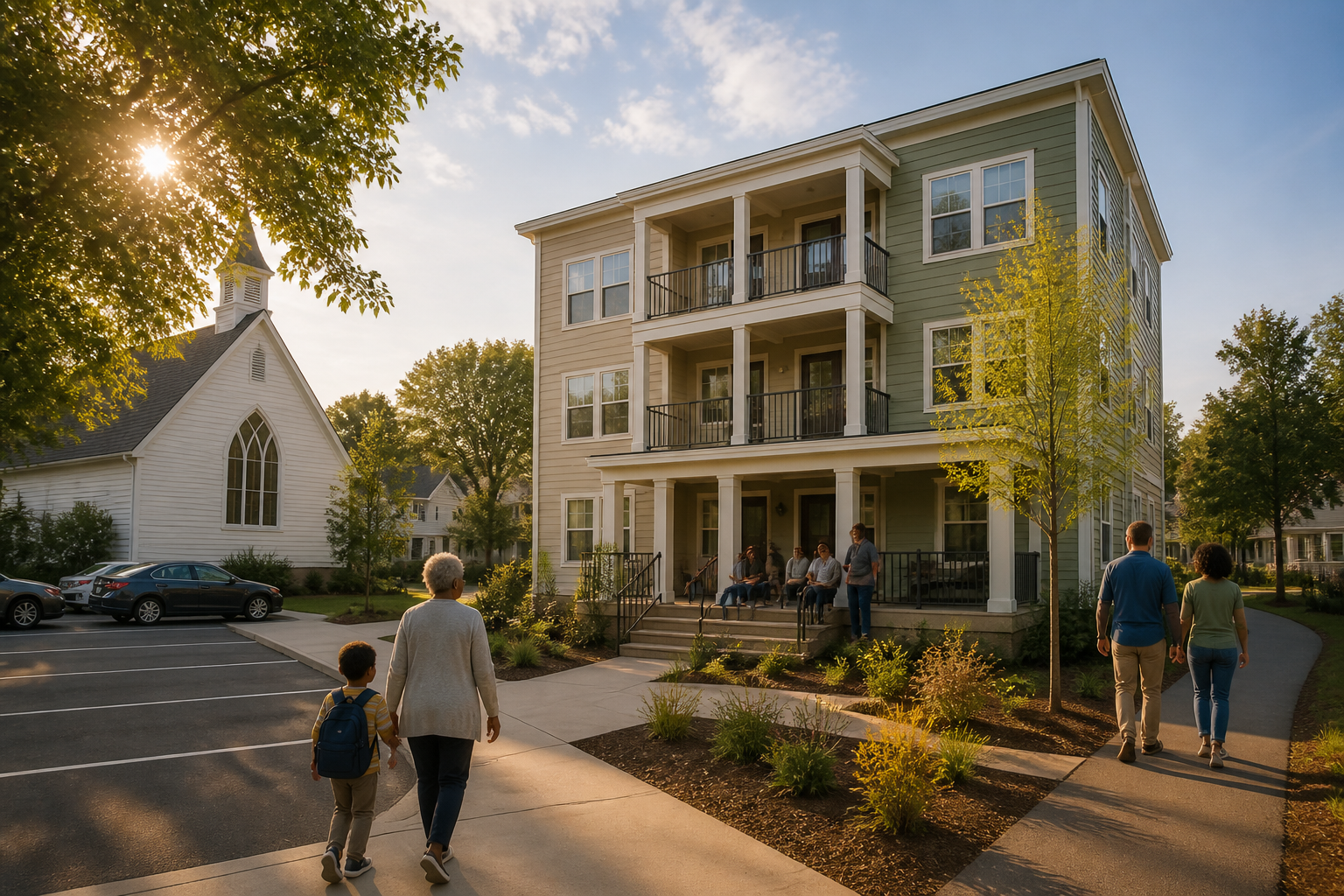
Across the country, congregations are looking at their parking lots, vacant rectories, and underused parcels and asking a practical question: could this land house our neighbors? The Yes In God's Backyard faith housing movement — widely shortened to YIGBY — is the organized answer to that question. It pairs the real estate that religious institutions already own with the policy reforms, financing, and development know-how needed to turn that land into homes families can actually afford. This guide explains what YIGBY is, how state laws are clearing the path, the partnership models congregations are using, and how cooperative ownership can keep the resulting housing affordable for generations.
What "Yes In God's Backyard" Actually Means
YIGBY is a deliberate play on NIMBY — "Not In My Backyard," the reflexive local opposition that has slowed housing production for decades. Where NIMBY says no, YIGBY communities of faith say yes, and they say it about their own ground.
The movement began in San Diego, where housing advocates and clergy organized around a simple observation: faith communities collectively hold an enormous amount of well-located, underused land. Houses of worship tend to sit in established neighborhoods, near transit, schools, and jobs — exactly where housing is most needed and hardest to build. Much of that land is given over to surface parking that fills only a few hours a week.
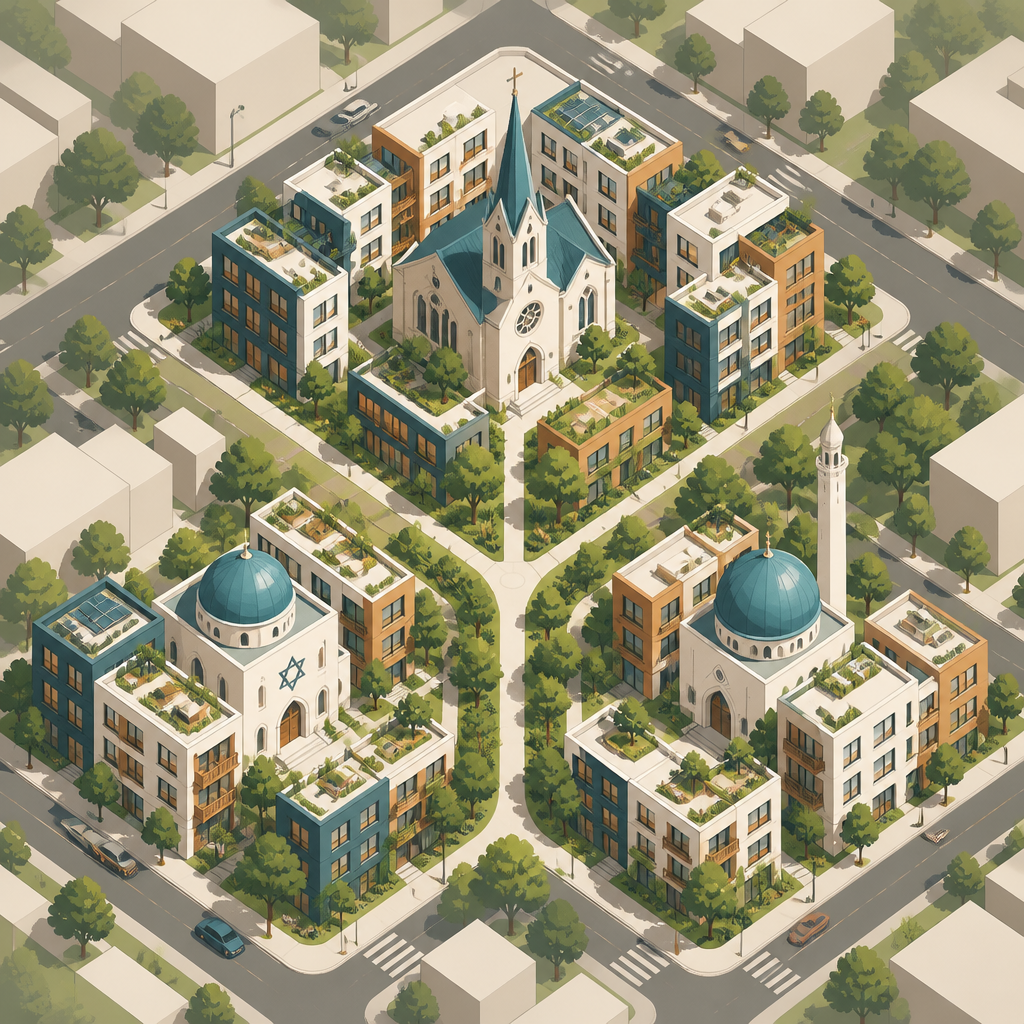
YIGBY is ecumenical by design. The coalition spans Catholic parishes, mainline and historically Black Protestant churches, evangelical congregations, synagogues, mosques, and temples. Different traditions describe the work in their own theological language — stewardship, tikkun olam, sadaqah, hospitality to the stranger — but the underlying conviction is shared: land held by a faith community is a trust, and housing the vulnerable is a faithful use of it.
Why Faith-Owned Land Is Such a Powerful Opportunity
The numbers behind the movement are striking. A University of California, Berkeley study of California's faith-land law found it opens roughly 170,000 acres — about half the land area of Los Angeles — to potential affordable development statewide. Advocates in Massachusetts estimate that using even a quarter of vacant faith-owned land could yield up to 250,000 new homes.
Beyond raw acreage, faith-owned sites carry advantages that make them unusually well suited to affordable housing:
- Location. Congregations are embedded in walkable, transit-served neighborhoods rather than the urban fringe.
- Mission alignment. A faith community building homes for low-income seniors, veterans, or working families is acting on its values, not against them — which often softens the neighborhood opposition that stalls market-rate projects.
- Long time horizons. Religious institutions are not flippers. They tend to hold property for generations, which aligns naturally with the patient, long-term ownership that durable affordability requires.
- Existing trust. Congregations already know their neighbors. That social capital makes outreach, tenant selection, and ongoing stewardship easier than for an outside developer.
There is also a survival dimension. Many congregations face shrinking membership and rising maintenance costs on aging buildings. Housing development can provide ground-lease income or a capital infusion that keeps the sanctuary's lights on, letting a community preserve its worship space while serving its mission in a new way.
How State Laws Are Clearing the Path
For years, the biggest obstacle was not the will to build but the zoning code. Land zoned for a church often cannot host apartments without a discretionary rezoning — a slow, expensive, politically fraught process that kills many projects before they start. A wave of state legislation is changing that.
California: SB 4
California's SB 4, in effect since the start of 2024, lets nonprofit colleges and religious institutions build 100% affordable housing "by right" on land they own, bypassing the special zoning approvals a city would otherwise demand, so long as the project meets state criteria. "By right" is the key phrase: it means a qualifying project cannot be blocked through discretionary local review, which dramatically shortens timelines and reduces risk.
Washington: HB 1377
Washington's HB 1377 grants a density bonus for 100% affordable housing built on property owned by religious institutions, increasing the number of units a congregation may build — though local jurisdictions still help set the scope of that bonus.
Connecticut, Massachusetts, and a Growing List
Connecticut advanced a YIGBY bill in 2026 that would allow "summary review" of affordable housing on church property, approving zoning-compliant projects without a public hearing or other procedural hurdles. Massachusetts housing advocates, organized through groups like CHAPA, continue to push their own version. The map of YIGBY-style reform keeps expanding as legislators see early projects succeed.
These laws share a common logic: where a faith community proposes deeply affordable housing on its own land and meets objective standards, the project should move forward without being held hostage to case-by-case politics.
Federal Momentum: The 21st Century ROAD to Housing Act
State reform is now reinforced at the federal level. The 21st Century ROAD to Housing Act (H.R. 6644) was passed by Congress in June 2026 (now law as of July 2026). Of particular relevance to faith communities exploring shared-ownership models, the bill's Velázquez provisions explicitly authorize housing cooperatives within federal housing programs — provisions aimed at a cooperative sector already home to roughly 1.5 million families.
This matters because, until recently, co-ops occupied an awkward gap in federal housing finance, recognized in some programs and excluded from others. Clearer federal authorization gives congregations and their partners a more reliable path to choosing cooperative ownership — not just rental — when they decide what kind of housing to build. For a faith community that wants residents to build equity and have a real voice, that is a meaningful new option.
Partnership Models for Congregations
Most congregations are not, and do not want to become, real estate developers. The good news is that they don't have to. Several proven structures let a faith community contribute what it has — land and trust — while partners supply the rest.
Ground Lease to a Nonprofit Developer
The congregation retains ownership of the land and leases it long-term (often 65–99 years) to an experienced affordable housing developer. The developer finances, builds, and operates the housing; the congregation receives lease payments and keeps its underlying asset. This is one of the most common YIGBY structures because it limits the congregation's risk while preserving long-term control.
Joint Venture
The faith community partners more deeply with a developer or community development corporation, sharing in decisions and, sometimes, in returns. This gives the congregation more influence over design, tenant mix, and community programming, in exchange for taking on more responsibility.
Sale or Donation with a Mission Covenant
Some congregations transfer land to a mission-aligned nonprofit or community land trust, attaching covenants that lock in affordability and intended use. This works well for communities that want to ensure the outcome but step back from ongoing operations.
Congregation-Led Development
A smaller number of well-resourced or coalition-backed congregations develop housing themselves, often forming a nonprofit affiliate. This path offers the most control and the steepest learning curve — and is where strong planning tools and technical partners matter most.
In one widely cited example, the San Diego nonprofit behind the YIGBY movement partnered with Bethel AME Church to support a 26-unit development for low-income seniors and homeless veterans, which broke ground in 2024 and was completed in late 2025. It illustrates the model end to end: faith-owned land, a capable partner, and homes for people who needed them.
Cooperative Ownership: Keeping Affordability Permanent
Building affordable housing is one challenge. Keeping it affordable is another. A project financed with a 30-year affordability covenant can revert to market rates when that covenant expires — losing the very homes the congregation worked to create.
Cooperative ownership offers a durable answer, and it aligns unusually well with faith communities' long time horizons and communitarian values. In a housing cooperative, residents collectively own the entity that owns the building. Rather than paying a landlord, members buy a share and pay a monthly carrying charge that covers operating costs and debt. In a limited-equity cooperative, resale prices are capped by formula, so homes stay affordable for the next family while members still build modest equity and gain the stability of ownership.
For a congregation, cooperative ownership can be especially attractive because it:
- Locks in long-term affordability rather than relying on a covenant that eventually expires.
- Builds resident wealth and stability, advancing economic justice goals many faith traditions share.
- Embeds democratic governance, giving residents a genuine voice — a structure that resonates with congregational and community values.
- Aligns with federal support, now reinforced by the cooperative provisions in the 21st Century ROAD to Housing Act.
A congregation might, for instance, ground-lease its land to a limited-equity cooperative formed by future residents, pairing the faith community's stewardship of the land with the residents' stewardship of their homes.
Common Hurdles — and How They Get Solved
YIGBY projects are achievable, but they are not automatic. The recurring challenges are predictable:
- Capital stacks are complex. Affordable housing typically braids together tax credits, soft loans, grants, and sometimes congregational equity. Modeling that stack accurately is essential and is where many faith-led efforts stall.
- Predevelopment is expensive and risky. The early dollars for studies, design, and entitlement come before any financing is secured.
- Internal alignment takes time. Congregations are deliberative bodies. Building consensus across members, leadership, and denominational structures is real work.
- Technical knowledge is scarce. Few congregations have in-house expertise in zoning, finance, or construction.
Each of these is solvable with the right partners and the right tools. Clear financial modeling de-risks the capital stack. Honest feasibility analysis prevents wasted predevelopment spending. Transparent planning materials help a congregation reach internal alignment with eyes open.
How Built By DAO + Blueprint Fit In
Built By DAO is a venture studio for community-owned development. Our flagship software, Blueprint, is built to help mission-driven groups — including faith communities — plan, finance, and launch affordable housing cooperatives.
Blueprint is designed to meet congregations exactly where YIGBY projects get hard. It helps you model the full capital stack, test whether a site is financially feasible before you spend on predevelopment, structure cooperative ownership so affordability stays permanent, and produce clear materials your leadership and members can actually understand and rally behind. In short, it turns "we own land and want to help" into a concrete, financeable plan — and pairs naturally with the cooperative ownership now reinforced by federal law.
If your congregation is sitting on land and wondering whether you could house your neighbors, that question deserves a real answer rather than a guess.
Explore how Blueprint can help your community plan and finance an affordable housing cooperative: blueprint.builtbydao.com
Frequently Asked Questions
What does YIGBY stand for?
YIGBY stands for "Yes In God's Backyard." It is a movement — and a coalition of advocates, clergy, and developers — encouraging faith communities to build affordable housing on land they already own, framed as the constructive opposite of NIMBY ("Not In My Backyard").
Is YIGBY tied to one religion?
No. The movement is intentionally ecumenical. Churches, synagogues, mosques, temples, and other faith communities across traditions participate, each drawing on its own theology of stewardship, justice, and hospitality. The shared idea is that faith-owned land can be used to house people in need.
Do faith communities have to become developers to participate?
Not at all. Most congregations partner with experienced affordable housing developers or nonprofits through structures like a long-term ground lease or a joint venture. The congregation typically contributes land and community trust while partners handle financing, construction, and operations.
How do state laws like California's SB 4 help?
Laws such as California's SB 4 let religious institutions build 100% affordable housing "by right" on their land, bypassing discretionary local zoning approvals that previously stalled projects. Washington, Connecticut, Massachusetts, and other states have advanced similar reforms that streamline or incentivize faith-land housing.
Why choose a cooperative instead of standard rental housing?
A cooperative — especially a limited-equity cooperative — keeps homes permanently affordable rather than relying on a covenant that expires, lets residents build modest equity and gain ownership stability, and gives them a democratic voice in governance. These features align well with faith communities' long time horizons and values, and are now reinforced by federal cooperative provisions in the 21st Century ROAD to Housing Act.
Where can a congregation start?
Start by understanding your land's potential and financial feasibility before committing to predevelopment costs. Tools like Blueprint help model the capital stack, test feasibility, and structure cooperative ownership — and connecting with a YIGBY coalition or a mission-aligned developer in your region is a strong next step.